

Ditwah & Senyar highlight need for stronger BIMSTEC climate diplomacy
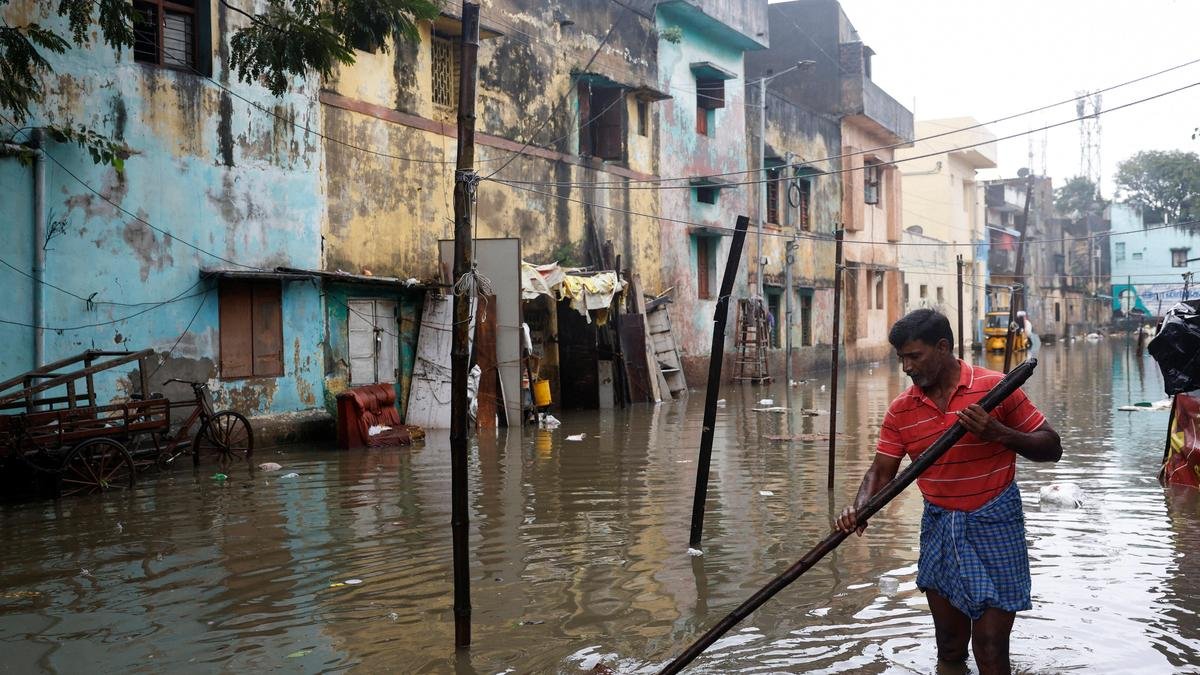
A man tries to clear a drain on a waterlogged street after heavy rains triggered by Cyclone Ditwah in Chennai, India, December 2, 2025
| Photo Credit:
PRIYANSHU SINGH
While climate change cannot be directly blamed for triggering two unusual cyclones Senyar and Ditwah one after the other over Bay of Bengal and uncharted Strait of Malacca, conditions favouring formation of such intense and erratic weather systems are undeniably rising over these parts.
The devastating impact of the twin cyclones on Sri Lanka; India; Indonesia; and Thailand reveal a rapidly changing climate system and highlight why BIMSTEC (Bay of Bengal Initiative for Multi-Sectoral Technical and Economic Cooperation) must strengthen joint preparedness; early warnings; and climate diplomacy.
Not isolated events
Ditwah and Senyar are not isolated events; they are early signals of a changing climate, says Sanjay Srivastava, S Radhakrishnan Chair Professor, National Institute of Advanced Studies (NIAS), Indian Institute of Science Campus, Bengaluru. He was formerly Chief of Disaster Risk Reduction, at UN-ESCAP, Bangkok.
The Bay is entering an era of extreme, unpredictable risks. BIMSTEC must respond with urgency, cooperation, and visionary climate leadership, he told businessline.
High-octane fuel
As greenhouse gas emissions warm the oceans and atmosphere, tropical cyclones gain more energy and rainfall extremes intensify. A hotter ocean acts as high-octane fuel for storms, while a warmer atmosphere supercharges the water cycle, increasing peak rainfall rates.
The Bay is rapidly becoming a global climate-risk hotspot. Transboundary flooding is intensifying in the Ganga–Brahmaputra–Meghna; Ayeyarwady; and Mekong river basins. Cyclones and monsoon push millions into climate-induced loss and damage across India; Bangladesh; Myanmar; Sri Lanka; Thailand; Bhutan; and Nepal.
Unusual trajectory
It is in this context that Ditwah, that swept across Sri Lanka’s east coast, and Senyar, that formed near the equator in the Strait of Malacca, need to be analysed, Srivastava pointed out.
Ditwah reared over unusually warm waters, swept moisture-laden winds across Sri Lanka; Tamil Nadu; and Coastal Andhra Pradesh in adjoining India. Tracking directly up Sri Lanka’s east coast, an unusual trajectory by itself, it submerged farmlands; crippled transport; and exposed deep vulnerabilities in regional preparedness.
Rare spot of genesis
Earlier, Senyar had stunned meteorologists thanks to the sheer exclusivity of area of its genesis. Cyclones rarely form near the equator due to weak Coriolis forces, yet Senyar emerged just north of the equator in the Strait of Malacca, only the second such cyclone ever recorded.
As it intensified rainfall across Aceh and North Sumatra, Indonesia was already grappling with repeated floods and landslides from West Java to Central Sulawesi and Sumatra. Thailand faced its own monsoon-amplified deluges, submerging towns and economic centres.
Climate intelligence
This is where BIMSTEC’s leadership is crucial, Srivastava pointed out. A recent dialogue convened by the Asian Disaster Preparedness Centre and the BIMSTEC Secretariat in Bangkok underscored the urgent need for coordinated regional action.
India’s proposal to strengthen the BIMSTEC Disaster Management Centre by building on existing BIMSTEC Weather and Climate Centre, offers a strong foundation. BIMSTEC can also pioneer a regional climate intelligence platform linking hydro-met agencies; river-basin authorities; and scientific institutions enabling shared risk maps; real-time monitoring; and anticipatory action.
Powerful tools
Nalanda University’s dedicated Centre for BIMSTEC Studies emphasises the region’s deep cultural ties in terms of shared histories; monsoon traditions; river civilisations; and community coping practices, can be powerful tools for building collective resilience to shared risks and vulnerabilities.
Climate diplomacy through BIMSTEC can amplify the region’s voice on adaptation finance; loss and damage; and resilient infrastructure at global forums, including COP processes, Srivastava stressed.
Published on December 2, 2025

