


“Brain Ages, Breast Cancer Immunity & Cosmic Motion 2025”
A representative MRI tractography image of the general pattern seen across the human brain in the first era of its neural wiring: 0-9 years of age.
| Photo Credit: Alexa Mousley, University of Cambridge
The five ages of the human brain
William Shakespeare wrote of the seven ages of man in his play As You Like It. Now, neuroscientists of the University of Cambridge, UK, have identified five distinct ages of the human brain: the different phases or epochs respectively beginning at ages 9, 32, 66, and 83 on average when the architecture of the brain’s neural network changes in identifiably different ways, influencing the way we think and process information as life progresses.
In a study published in Nature Communications, the scientists compared the brains of 3,802 people aged between 0 and 90 using datasets of magnetic resonance imaging (MRI) diffusion scans, which map neural connections by tracking how water molecules move through brain tissue. They detected five broad phases of brain structure in the average human life, divided by four pivotal “turning points” when our brains reconfigure.
The connections among the brain’s neurons seem to remain wired much the same way from birth to 9 years of age. Then, with the coming of adolescence, the architecture begins to organise differently, continuing until the age of 32. At this point, the brain’s structural development appears to peak, the “strongest topological turning point” of the entire lifespan, with the brain’s wiring shifting into adult mode. This is the longest era, which lasts over three decades.
A third turning point around, age 66, marks the start of an “early aging” phase of brain architecture. Finally, the “late aging” brain takes shape at around 83 years old.
This does not mean that the brains of a 17-year-old and 30-year-old are the same. The types of changes occurring during the phase are, however, consistent, said Alexa Mousley, who led the research. At age 32, the brain’s longest rewiring era begins and the brain architecture starts to stabilise, and around this time there is a plateauing of intelligence and personality, according to previous research.
The turning point at age 66 is far milder and not defined by any major structural shifts, although researchers found meaningful changes to the pattern of brain networks at around this age. “The data suggest that a gradual reorganisation of brain networks culminates in the mid-60s,” said Mousley. “This is probably related to aging, with further reduced connectivity as white matter starts to degenerate.”
The last turning point comes around age 83, the start of the final brain structure epoch. The data, however, is limited for this era. The chief feature in this phase is a shift from global to local as whole brain connectivity declines further, with increased reliance on certain regions.
“These eras provide important context for what our brains might be best at, or more vulnerable to, at different stages of our lives. It could help us understand why some brains develop differently at key points in life, whether it be learning difficulties in childhood or dementia in our later years,” she added.

A study by a team of researchers in Australia provides a biological explanation for the protective effect of childbearing and shows how this has a lasting impact on a woman’s immune system.
| Photo Credit:
Getty Images
Breastfeeding boosts immune cells that give protection against breast cancer
Although it has been known for some time that having children reduced a woman’s breast cancer risk, the reasons were not fully understood; pregnancy-related hormonal changes were thought to be a major factor. Now, a study by a team of researchers from the Peter MacCallum Cancer Centre, Melbourne, Australia, led by Sherene Loi, provides a biological explanation for the protective effect of childbearing and shows how this has a lasting impact on a woman’s immune system. The study was published recently in Nature.
“We found that women who have breastfed have more specialised immune cells, called CD8⁺ T-cells, that ‘live’ in the breast tissue for decades after childbirth,” Loi said. “This protection may have evolved to defend mothers during the vulnerable post-pregnancy period, but it also lowers breast cancer risk, especially the aggressive type called triple-negative breast cancer.” According to her, completing a full cycle of pregnancy, breastfeeding, and breast recovery causes these T-cells to accumulate in the breast.
The protective effect was confirmed in preclinical experiments. “When breast cancer cells were introduced, the [mice] models with this reproductive history were far better at slowing or stopping tumour growth but only if T-cells were present,” she said. “We also studied data from over 1,000 breast cancer patients and found women who breastfed had tumours with higher numbers of these protective T-cells, and in some groups, they lived longer after diagnosis of breast cancer.”
Understanding the immune changes within the breast tissue that this research points to could lead to entirely new approaches to prevent and treat breast cancer.
Also Read | Spooky action at the Hadron Collider; the milk of human kindness; and a cosmic goliath
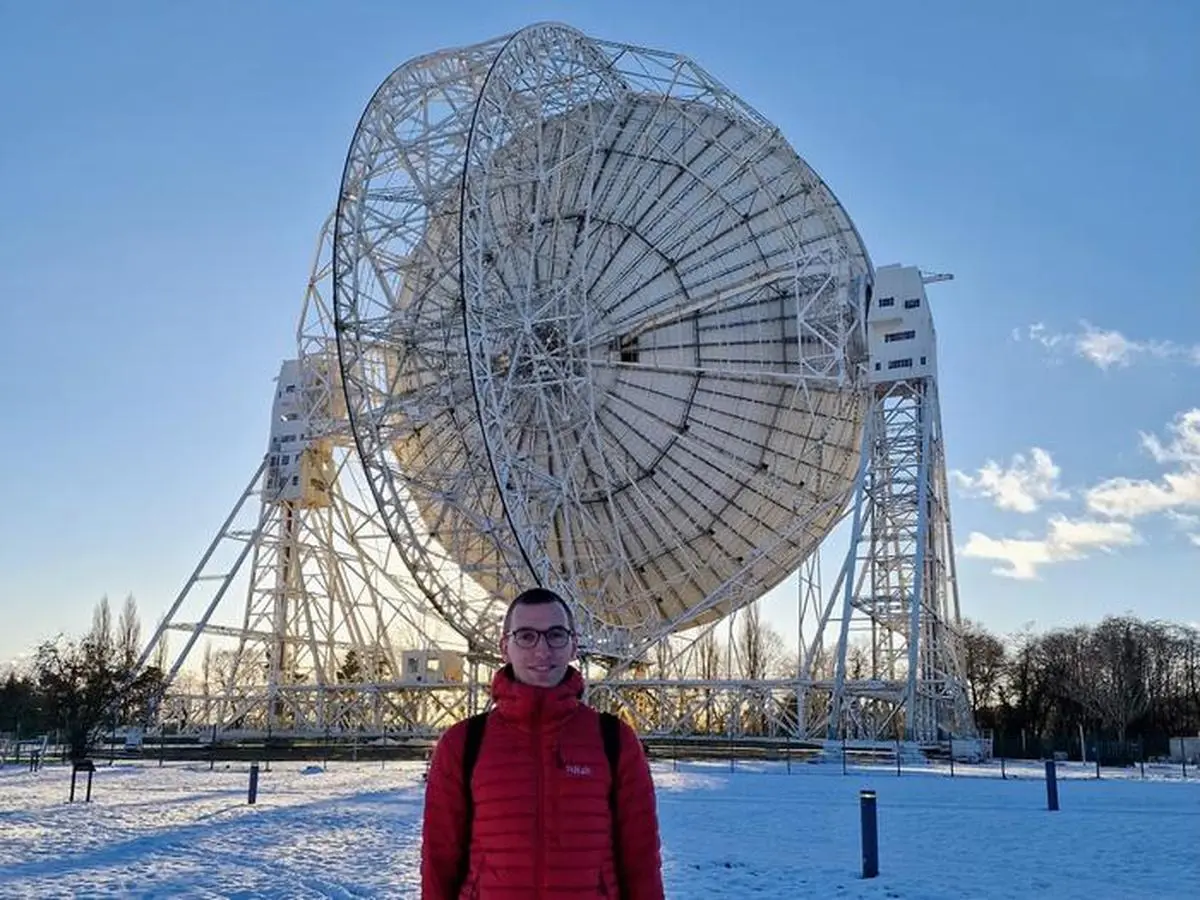
The Bielefeld University scientist Lukas Böhme in front of the Lovell Telescope at the Jodrell Bank Radio Observatory in the UK.
| Photo Credit:
Lukas Böhme
Our solar system is moving faster than predicted
How fast and in which direction is our solar system moving through the universe? This seemingly simple question is one of the key tests of our cosmological understanding. What a research team at Bielefeld University, Germany, has now found challenges the established standard model of cosmology. The study’s findings were recently published in Physical Review Letters.
“Our analysis shows that the solar system is moving more than three times faster than current models predict,” said the lead author Lukas Böhme. “This result clearly contradicts expectations based on standard cosmology and forces us to reconsider our previous assumptions.”
To determine the motion of the solar system, the team analysed the distribution of radio galaxies, which are distant galaxies that emit particularly strong radio waves. Because dust and gas that obscure visible light are transparent to radio waves, radio telescopes can observe galaxies invisible to optical instruments. As the solar system moves through the universe, this motion produces a subtle “headwind”: slightly more radio galaxies appear in the direction of travel. The difference is tiny and can be detected only with extremely sensitive measurements.
Using data from the LOFAR (Low Frequency Array) telescope, a Europe-wide radio telescope network, combined with data from two additional radio observatories, the researchers were for the first time able to make an especially precise count of such radio galaxies. They applied a new statistical method that accounts for the fact that many radio galaxies consist of multiple components. This improved analysis yielded larger but also more realistic measurement uncertainties. The combined data from the three radio telescopes revealed a deviation exceeding five sigma, a statistically strong indicator of a significant result.
The measurement showed an anisotropy (“dipole”) in the distribution of radio galaxies that is 3.7 times stronger than predicted by the standard model of the universe, which posits a largely uniform matter distribution in the cosmos since the big bang and subsequent evolution. “If our solar system is indeed moving this fast, we need to question the fundamental assumptions about the large-scale structure of the universe,” said Professor Dominik J. Schwarz, co-author of the study. “Alternatively, the distribution of radio galaxies itself may be less uniform than we have believed. In either case, our current models are being put to the test.”
The new results confirm earlier observations in which researchers studied quasars, the extremely bright centres of distant galaxies where supermassive black holes consume matter and emit enormous amounts of energy. The same unusual effect appeared in these infrared data, suggesting that it is not a measurement error but a genuine feature of the universe.

