

AI’s productivity payoff yet to move the needle for IT cos
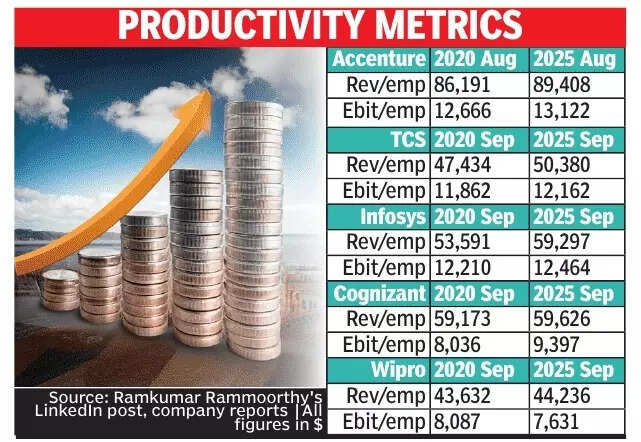
Getting real with AI by tracking audited metrics is the need of the hour for IT firms. While companies highlighted aggressive AI adoption by giving out the percentages of new code generated by AI and workforce skilling metrics, audited financial data that presents the real productivity impact is yet to fully show up. A comparison of productivity metrics since 2020 shows that the much-touted AI push did not deliver a step-change in per-employee economics across global and Indian IT services firms. This is despite revenue growth being supported by M&A-led expansion and a sharply depreciating rupee, raising questions around the pace of underlying organic growth. Overall, the top 10 Indian IT services firms spent about $4.3 billion on acquisitions over the same period, underscoring the sector’s reliance on M&A to bolster growth. Infosys, HCL Tech, and Wipro spent about $1 billion to acquire 7 companies in the first 9 months of the current fiscal. In 2024, Cognizant made two major acquisitions, including its second largest ever—the $1.3 billion purchase of US engineering R&D firm Belcan—along with the $430 million acquisition of ServiceNow partner Thirdera. More recently, it acquired 3Cloud to strengthen its Azure capabilities. Further, companies also became aggressive with large deals, promising ever-higher productivity gains and driving revenue growth by booking licence sales of software products such as Salesforce and Workday in their books to boost the revenue line. The data, compiled from a LinkedIn post by Ramkumar Ramamoorthy, partner at growth advisory firm Catalincs, compares pre- and post-pandemic productivity metrics, particularly after the launch of ChatGPT in November 2022. Accenture’s revenue per employee rose only marginally from $86,191 in August 2020 to $89,408 in August 2025, despite averaging more than a dozen acquisitions annually. EBIT per employee increased by just 3.6% over the same period. Notably, Accenture—one of the first firms to explicitly disclose AI revenue—said it will no longer report AI revenues separately, citing the deep embedding of AI across its core offerings rather than standalone projects.
–
Among Indian peers, Infosys shows the strongest structural improvement, with revenue per employee rising from $53,591 in September 2020 to $59,297 in September 2025, though EBIT and net profit per employee remain largely flat. TCS recovered from its post-pandemic dip, lifting revenue per employee from $47,434 to $50,380, but EBIT per employee is only marginally above 2020 levels. In contrast, TCS recently called out AI revenue for the first time, with CEO K Krithivasan saying AI services reached $1.5 billion in annualised revenue, growing 16.3% quarter-on-quarter. Cognizant’s revenue productivity remained largely flat over 5 years, even as EBIT per employee improved through cost control, while Wipro continues to lag, with both revenue and EBIT per employee in 2025 still trailing or barely matching 2020 levels. “Despite massive forces such as large acquisitions, extreme offshoring driven by the pandemic and recent immigration changes, and a sharp depreciation of the rupee, metrics like revenue per employee, EBIT per employee and net profit per employee remained largely flat for large IT services companies,” Ramamoorthy said. While the picture may appear sobering, he added that firms are still in the early stages of building AI-ready talent and scalable use cases. “Only when enterprise-grade deployments happen at scale, these metrics move meaningfully. The next 12–24 months will be pivotal in translating AI’s promise into measurable business impact,” he added.

