



Adani group to commercially develop 240 acres at Navi Mumbai airport: Jeet Adani
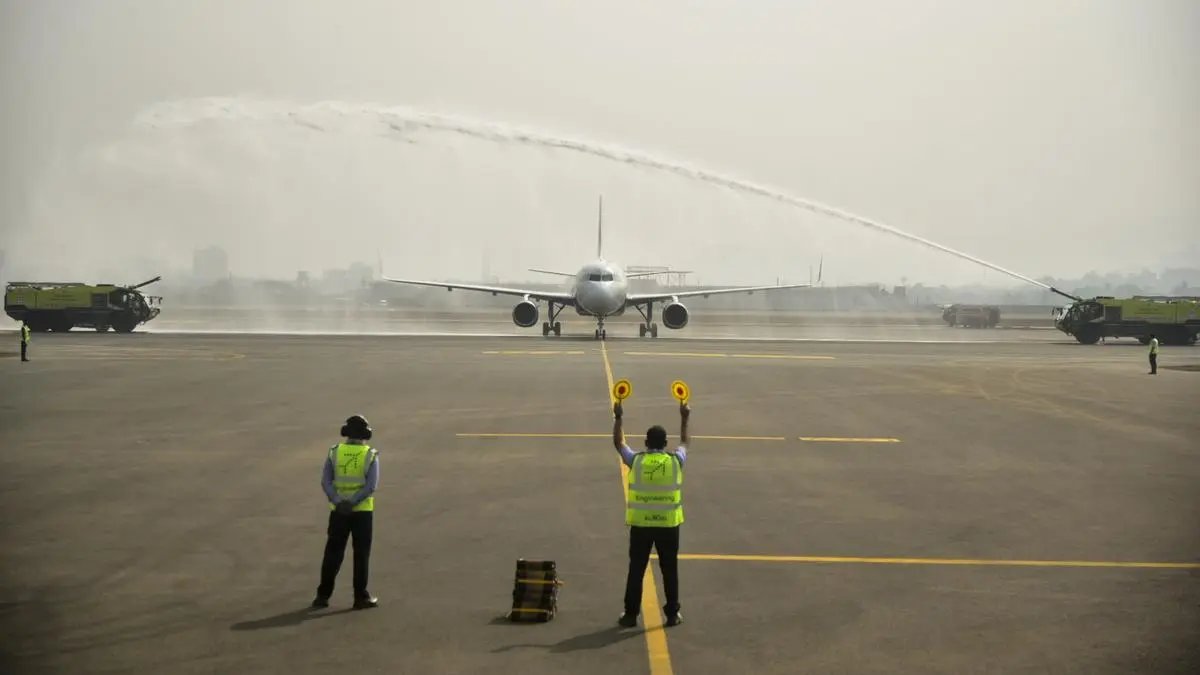

File Photo: An aircraft makes its landing at Navi Mumbai International Airport
| Photo Credit:
PTI
The long-delayed Navi Mumbai airport will begin functioning on December 25. In the first month it will see 30 flights including departures and arrivals with operations scaling up gradually. Jeet Adani, director of Adani Airports, spoke to media persons about Navi Mumbai airport, IPO plans, expansion of pilot training centres etc.
Originally, the Navi Mumbai airport was to start functioning from August and projected passenger traffic for FY26 was 12 million. In the backdrop of IndiGo meltdown and delay in airport launch, what is outlook for traffic growth?
We are now looking at 12 million passengers in FY27. We are expecting a couple of million passengers this fiscal year because you barely have 2-3 months left. And then by the year after that, the airport should be at full 20 million capacity. By then, we will also see a combined tariff with same aeronautical rates for Mumbai and Navi Mumbai airports. Both the City and Industrial Development Corporation and Airport Authority of India have agreed in principle to adopt a combined tariff. It is also being looked at quite positively by the Airport Economic Regulatory Authority which is working on the methodology for a combined tariff.
Can you tell us about non-aeronautical development plans at Navi Mumbai airport ?
At Navi Mumbai, we have about 240 acres of land which is developable on the city side. We plan to develop it ourselves at least in the first two phases. It will be a mixed-use development comprising commercial real estate, hospitality and retail. We are also doing a 25,000-seat arena for live entertainment in partnership with one of the major operators. In the first phase we are developing about 5 million square feet and then every year 2 to 3 million square feet will keep getting added.
There was a plan to demolish Terminal 1 at Mumbai airport. What is the status?
The demolition will happen in 2030. We are looking at passenger demand of Mumbai metropolitan region as a whole. With commissioning of Navi Mumbai airport, 20 million passenger handling capacity will be added but the total demand is still higher. That is why we are starting the development of the second terminal at Navi Mumbai in the next six months. Once T2 and the second runway at Navi Mumbai become operational in the next 3-3.5 years we will have some breathing room and that is when we can demolish and rebuild T1 at Mumbai airport.
What are the plans for cargo development at Navi Mumbai?
We will mostly start with belly cargo. Six to seven months down the line, we will move some of the freighters. Right now, we have seven freighter stands and we will add another four. FedEx is going to be one of our anchor customers at Navi Mumbai. FedEx is taking up a large facility to serve the entire parcel and overnight express business.
How much capex is being planned by Adani Group for its airports?
In five years, the total capex for airside, terminal and city-side development at all our airports will be around ₹1 lakh crore.
Is an IPO of Adani Airport Holdings Limited (AAHL) in the pipeline?
It could be either an IPO or a demerger, but that will not happen right now. 2027–2030 could be a good timeline. For the IPO, we are looking at three triggers. The first is, starting operations in Navi Mumbai airport which is happening now. AAHL also needs to generate its own cash. Right now, it still depends on Adani Enterprises Ltd (listed entity) for support. While the airport company is EBITDA-positive, it still depends on the listed entity for cash because of its large capex. And the third part is going to be leasing or sub-leasing of one of the city-side projects so that we can demonstrate value. So, it could be either an IPO or a demerger between 2027–2030.
Adani Group recently acquired pilot training organisation FSTC. What are the growth plans for that business?
FSTC has 15 simulators today. One of the things that is in focus in the IndiGo crisis is how we train more pilots. Our vision in the next 2–3 years is to increase the number of simulators from 15 to 50–60 across India. Right now FSTC has simulators in only two locations and we aim to put them in every major city.
Published on December 19, 2025

