










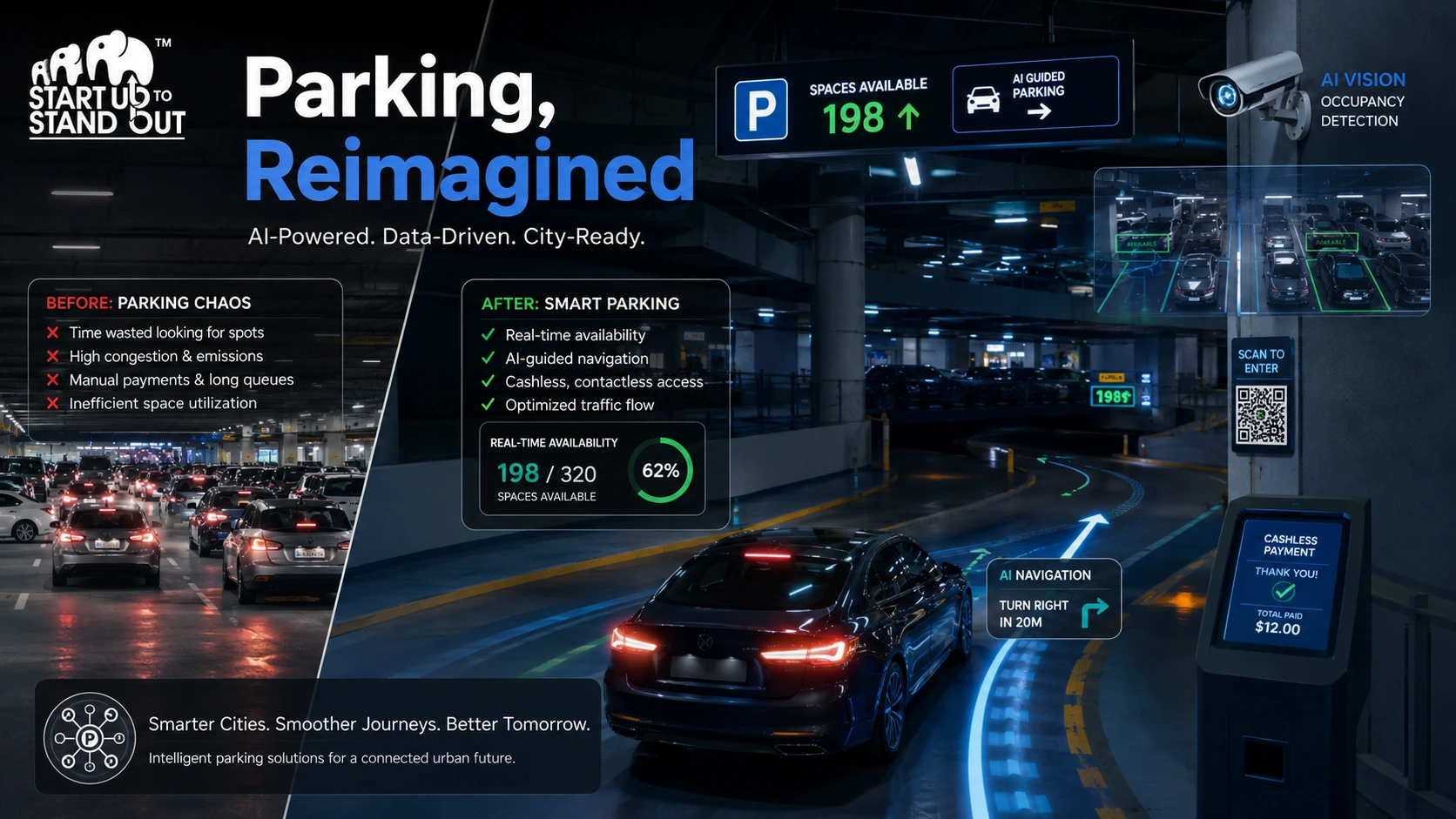
How AI-Powered Smart Parking Could Transform Urban Mobility
Introduction
For many urban drivers, finding a parking space is often more frustrating than the journey itself.
Drivers routinely spend valuable time circling parking lots, navigating crowded streets, and waiting in queues at parking entrances. The result is wasted fuel, increased congestion, higher emissions, and a poor overall experience.
At the same time, parking operators often lack visibility into how efficiently their parking assets are being used. Empty spaces remain undiscovered, pricing remains static regardless of demand, and operational inefficiencies limit revenue potential.
As cities become more crowded, parking is evolving from a simple infrastructure challenge into a data and mobility problem. AI-powered smart parking platforms are emerging as a solution by combining computer vision, analytics, automation, and digital payments to create a more efficient parking ecosystem.
Why Parking Remains a Major Urban Problem
Parking inefficiencies create ripple effects across entire cities.
Common challenges include:
- Drivers wasting time searching for spaces
- Increased fuel consumption
- Traffic congestion around high-demand locations
- Long queues at entry and exit gates
- Manual ticketing delays
- Underutilized parking capacity
These problems affect not only drivers but also businesses, municipalities, hospitals, airports, and commercial facilities that depend on efficient parking operations.
The issue is often not a lack of parking spaces—it is a lack of visibility into where those spaces are available.
The Shift Toward AI-Powered Parking
Traditional parking systems often rely on expensive physical sensors installed throughout parking facilities.
While effective, these systems can be costly to deploy and maintain.
A newer approach uses computer vision technology.
Instead of installing dedicated sensors in every parking spot, AI models analyze existing CCTV camera feeds to determine parking occupancy in real time.
This approach offers several advantages:
Lower Infrastructure Costs
Existing cameras can often be used without requiring major hardware investments.
Real-Time Visibility
Parking operators gain instant insight into occupancy levels and traffic flow.
Faster Deployment
Facilities can implement smart parking capabilities without extensive construction or retrofitting.
Scalable Growth
The software-based model allows expansion across multiple locations with minimal additional infrastructure.
Making Parking Easier for Drivers
One of the most valuable aspects of smart parking is the user experience.
Instead of driving around searching for available spaces, users receive real-time guidance.
Features can include:
- Live parking availability
- Space reservation
- Navigation assistance
- QR-code entry
- WhatsApp-based interactions
- Cashless payments
According to the proposal, drivers could potentially locate available parking in under two minutes through AI-assisted discovery and navigation tools.
By reducing uncertainty, the system improves convenience while reducing traffic congestion.
A New Revenue Model for Parking Operators
Smart parking creates opportunities that extend beyond operational efficiency.
For property owners and parking operators, data becomes a valuable business asset.
Dynamic Pricing
AI analytics enable pricing adjustments based on demand, helping maximize revenue during peak periods.
SaaS Subscriptions
Operators can subscribe to analytics dashboards that provide insights into parking utilization and customer behavior.
Transaction Fees
Digital payment systems create recurring revenue through small convenience charges.
Data Services
Parking utilization data can support broader transportation planning and urban mobility initiatives.
This combination of recurring software revenue and transaction-based income creates a scalable business model that differs significantly from traditional parking management approaches.
Smart Parking as Smart City Infrastructure
Parking may seem like a localized issue, but its impact extends across urban transportation networks.
Better parking management can contribute to:
Reduced Congestion
Drivers spend less time circulating in search of spaces.
Lower Emissions
Reduced vehicle idling decreases fuel consumption and carbon emissions.
Improved Traffic Flow
Real-time availability information helps distribute parking demand more efficiently.
Better Urban Planning
Aggregated parking data can support infrastructure investment and transportation policy decisions.
These benefits align closely with broader smart city initiatives focused on improving urban mobility and sustainability.
Building an Asset-Light Technology Business
One of the strongest aspects of the proposed model is its asset-light approach.
Rather than investing heavily in physical infrastructure, the business leverages:
- Existing CCTV systems
- Cloud computing platforms
- Payment gateways
- Navigation services
- Third-party hardware partners
This reduces capital requirements while allowing the company to focus on its core competitive advantage: software and artificial intelligence.
Such models are often more scalable because growth depends primarily on technology deployment rather than hardware ownership.
Insights & Analysis
The future of parking may increasingly resemble the evolution of ride-hailing and navigation services.
Historically, parking has been treated as static infrastructure. Smart parking transforms it into a dynamic, data-driven service.
The real value lies not only in helping drivers find spaces but also in creating a connected ecosystem where operators, businesses, municipalities, and consumers all benefit from better information.
As cities become more digitally connected, infrastructure that generates actionable data will become increasingly valuable.
Parking is one of the largest untapped datasets in urban mobility, making it a logical target for AI-driven innovation.
Conclusion
Parking may not be the first challenge people associate with technological disruption, but it is one of the most visible friction points in urban life.
AI-powered smart parking systems offer a practical solution by combining computer vision, analytics, automation, and seamless digital experiences.
For drivers, the benefits include reduced stress, faster parking, and lower travel friction.
For operators, the technology unlocks better utilization, increased revenue, and deeper operational insights.
For cities, it contributes to smarter transportation networks and more sustainable urban environments.
As urban populations continue to grow, intelligent parking infrastructure may become an essential component of the broader smart city ecosystem.
About the Authors
This article was collaboratively prepared by: