










How Portable Cryotherapy Could Make Elite Recovery Accessible to Everyone
Introduction
For decades, cryotherapy has occupied an unusual position in healthcare and sports science.
Its effectiveness in reducing inflammation, accelerating recovery, and supporting rehabilitation has been widely recognized. Elite athletes, professional sports teams, and specialized medical facilities have embraced cryotherapy as part of their performance and treatment protocols.
Yet despite its growing popularity, access remains limited.
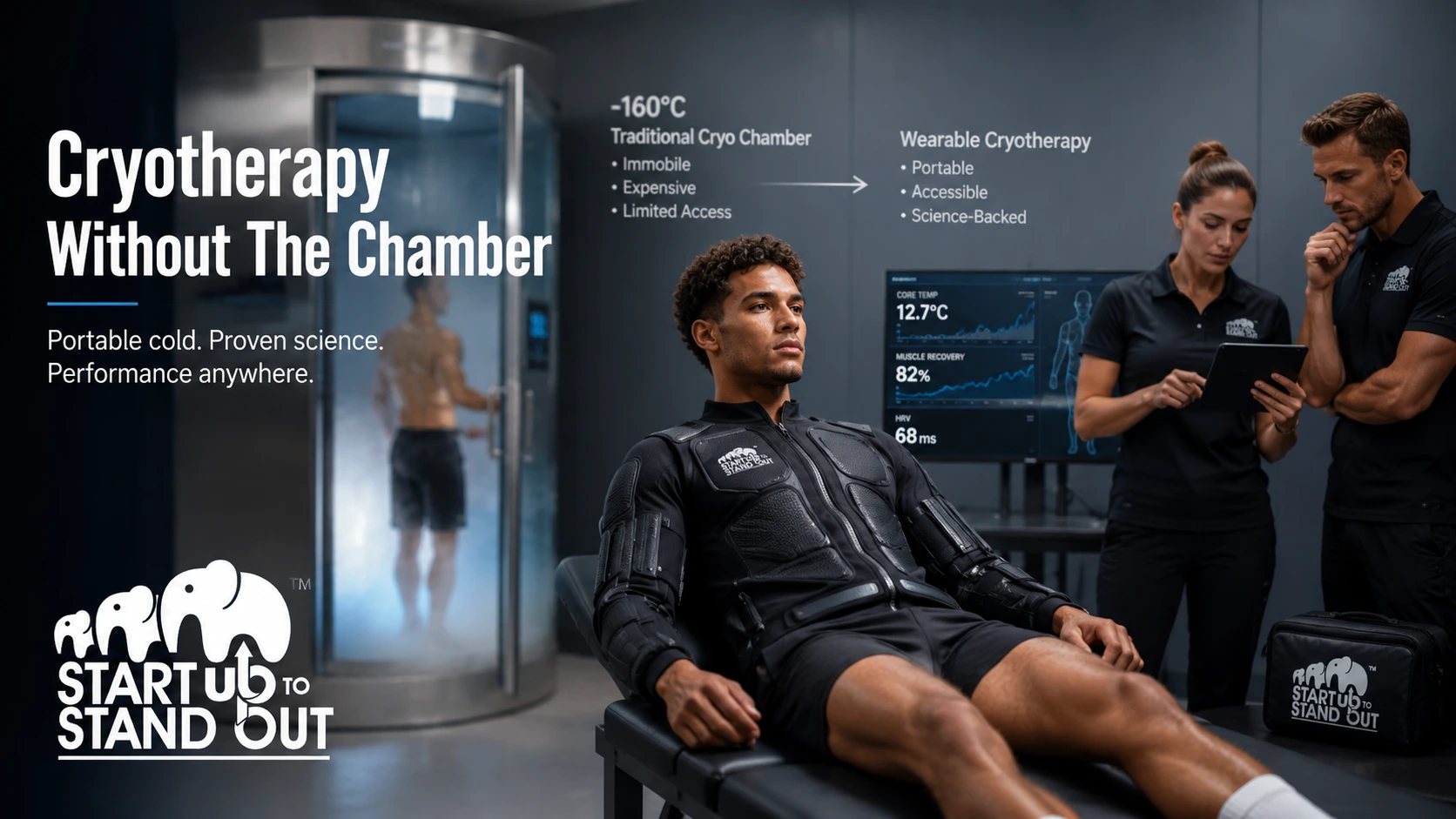
Traditional whole-body cryotherapy chambers cost between ₹80 lakh and ₹1.2 crore, require dedicated infrastructure, and depend on complex liquid nitrogen supply systems. For most hospitals, physiotherapy clinics, rehabilitation centers, and sports academies, these costs place cryotherapy firmly out of reach.
A new generation of portable cryotherapy technology aims to change that equation by transforming cryotherapy from a fixed facility investment into a wearable and accessible solution.
Why Cryotherapy Remains Inaccessible
Cryotherapy has traditionally relied on large chamber-based systems.
While effective, these systems present several challenges:
- Extremely high acquisition costs
- Dedicated installation requirements
- High power consumption
- Dependence on industrial liquid nitrogen supply chains
- Significant maintenance expenses
- Operational safety concerns
Portable alternatives exist, but many fail to deliver true cryotherapy temperatures or require constant technician supervision.
As a result, there remains a significant gap between demand for cryotherapy and practical access to it.
The Rise of Wearable Cryotherapy
The Cryogenic Jacket proposes a different approach.
Instead of requiring users to enter a specialized cryotherapy chamber, the technology delivers cryogenic temperatures through a wearable cooling system.
The device uses conductive cooling through aluminum-based thermal channels rather than relying solely on cold air circulation. According to the proposal, this approach can provide significantly greater thermal transfer efficiency than traditional cryotherapy chambers.
More importantly, the system is designed to be portable.
This means athletes, rehabilitation patients, and healthcare providers can potentially access advanced cryotherapy treatments without investing in large fixed installations.
A Flexible Dual-Cooling Architecture
One of the most interesting aspects of the technology is its dual-coolant capability.
The system can operate using:
Ethylene Glycol Cooling
Suitable for routine recovery and rehabilitation applications.
Liquid Nitrogen Cooling
Designed for full clinical-grade cryotherapy treatments that require extremely low temperatures.
This flexibility allows a single platform to serve multiple customer segments, ranging from sports recovery facilities to hospitals and specialized medical departments.
By addressing both wellness and medical use cases, the technology expands its potential market considerably.
Safety as a Competitive Advantage
Safety concerns have historically limited broader cryotherapy adoption.
Traditional nitrogen-based cryotherapy chambers can release nitrogen vapor into surrounding environments, creating risks that require specialized safety protocols and insurance coverage.
The wearable system attempts to address these concerns through:
- Closed-loop coolant circulation
- Emergency stop functionality
- Dead-man safety switches
- Thermal protection systems
- Automatic shutdown mechanisms
By eliminating ambient nitrogen release, the design reduces one of the most significant operational concerns associated with traditional cryotherapy installations.
Applications Beyond Professional Sports
While cryotherapy is often associated with elite athletes, its potential applications extend much further.
Rehabilitation Centers
Patients recovering from injuries may benefit from localized recovery treatments and inflammation management.
Physiotherapy Clinics
Portable systems allow clinics to offer advanced recovery services without major infrastructure investments.
Hospitals
Departments such as oncology, dermatology, and rehabilitation could integrate cryotherapy into treatment protocols.
Wellness Centers
Premium wellness facilities increasingly seek advanced recovery technologies to differentiate their offerings.
Sports Academies
Portable systems can bring recovery solutions directly to athletes at training facilities and competition venues.
Building a Scalable Business Model
The proposal outlines multiple revenue streams designed to support long-term growth.
These include:
Device Sales
Direct sales to hospitals, clinics, rehabilitation centers, and sports organizations.
Leasing Programs
Monthly or per-treatment rental models that lower adoption barriers.
Usage-Based Revenue
Commission structures tied to treatment volume.
Professional Services
Training, maintenance, onboarding, and certification support.
This combination of hardware sales and recurring revenue streams creates a business model that extends beyond one-time equipment purchases.
A Growing Market Opportunity
The timing of the product may be particularly favorable.
The global cryotherapy market continues to expand as healthcare providers, athletes, and wellness consumers seek non-invasive recovery solutions.
The proposal notes that portable cryotherapy solutions are growing faster than the broader cryotherapy market, reflecting increasing demand for mobility, convenience, and lower-cost deployment models.
This trend mirrors broader healthcare technology shifts toward portable and decentralized treatment solutions.
Insights & Analysis
The most significant innovation here may not be cryotherapy itself.
Cryotherapy already exists.
The real innovation is accessibility.
Historically, advanced recovery technologies often begin as premium services available only to elite institutions. Over time, successful innovations reduce cost, simplify deployment, and reach broader markets.
The Cryogenic Jacket follows that pattern.
By reducing infrastructure requirements while maintaining clinical capabilities, the model transforms cryotherapy from a facility-centered service into a deployable recovery platform.
If regulatory approvals and clinical validation proceed successfully, this approach could fundamentally change how recovery technologies are delivered in sports medicine and healthcare.
Conclusion
Cryotherapy has long been recognized for its therapeutic potential, but high costs and infrastructure requirements have limited widespread adoption.
Portable cryotherapy technology offers a compelling alternative.
By combining wearable design, advanced cooling systems, enhanced safety features, and flexible deployment models, the Cryogenic Jacket seeks to make clinical-grade cryotherapy more accessible than ever before.
For hospitals, rehabilitation centers, sports organizations, and wellness providers, the opportunity is not simply to improve recovery outcomes—it is to gain access to a category of treatment that was previously reserved for only the most well-funded institutions.
The future of cryotherapy may not be built around larger chambers. It may be worn directly by the people who need it most.
About the Authors
This article was collaboratively prepared by: