


Government plans Fertilizer Mission to cut imports, subsidies and chemical use
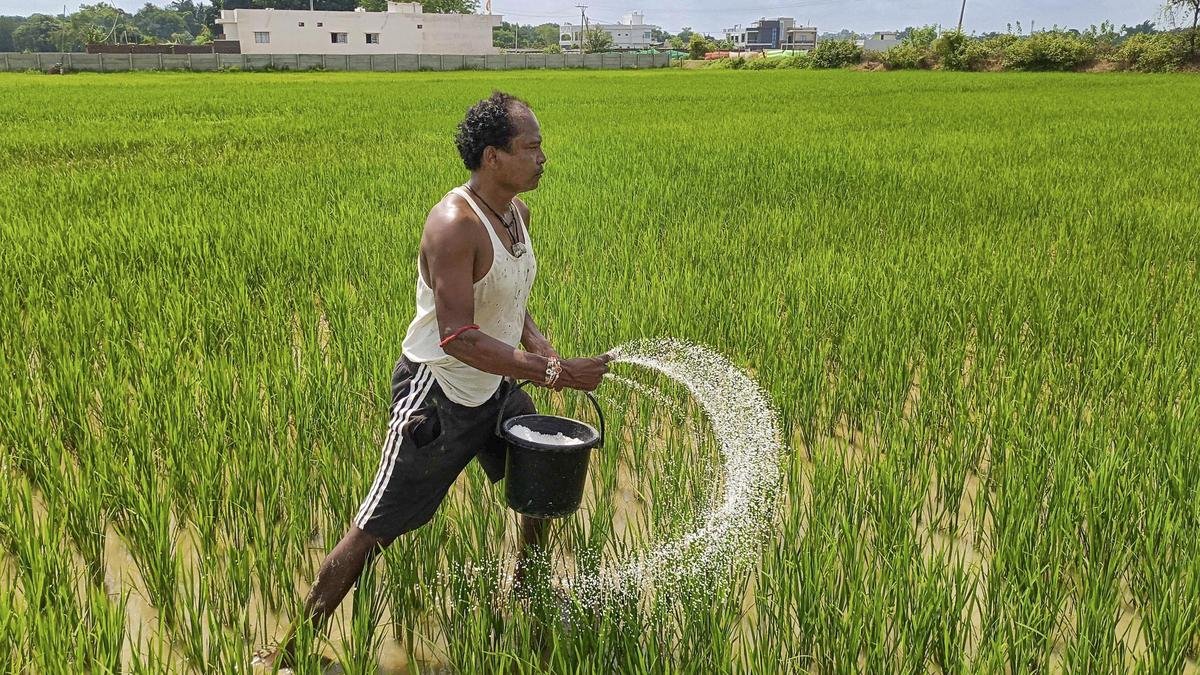

Urea sales rose 8.4% to 387.92 lakh tonnes (lt) last fiscal from 357.81 lt in 2023–24
| Photo Credit:
PTI
The government is likely to announce a Mission on Fertilizer in the upcoming Budget. The Mission is aimed at reducing the use of chemical fertilizers and cutting the subsidy bill. Sources said the Mission may also include incentives to promote alternatives, including bio-fertilisers, to reduce current chemical fertilizer imports by at least 20 per cent.
“The mission requires a five to ten-year horizon with specific targets. Reducing annual sales by even 6–7 per cent would offset the current rising trend, effectively keeping consumption at its present level,” said a source.
Sources said it may be named the “Mission for Self-Reliance in Fertilizer” with a target to cut imports by 20 per cent in five years or 35 per cent over 10 years.
Sales surge
India’s fertiliser sales in 2024-25 touched an all-time high of 655.94 lakh tonnes (lt), up from 600.79 lt in FY24. The previous high was 621.91 lt in 2020-21.
Latest official data show that urea sales reached 387.92 lakh tonnes (lt) during the last fiscal, 8.4 per cent higher than 357.81 lt in 2023-24. Muriate of Potash (MOP) was up 33.9 per cent to 22.02 lt from 16.44 lt and Complex (a combination of all nutrients) rose 28.2 per cent to 149.72 lt from 116.8 lt. The sale of Di-ammonium phosphate (DAP) declined to 96.28 lt from 109.74 lt, mainly due to scarcity till mid-November 2024.
Against the Budget Estimate (BE) of ₹1,67,899.5 crore for fertilizer subsidy, the government has disbursed ₹41,482.33 crore till June 30. However, the subsidy on phosphatic and potash fertilizers was subsequently raised to ₹75,000 crore from the initial ₹49,000 crore (BE).
Policy Convergence
Given the statistics, the thinking is to merge the PM-PRANAM scheme with the proposed Mission, as the former was promoted with the same objective. States are granted financial incentives for reducing the use of chemical fertilizers under the PM-PRANAM scheme. Many experts have advocated a revamp of this scheme amid rising sales.
Though not part of the proposed Fertilizer Mission, sources said, there may be higher allocations for the Mission on Natural Farming as its adoption is directly linked to reducing the use of chemical fertilisers. ICAR may also be tasked with developing new technologies that require lower use of nitrogen, phosphorus and potash.
Published on January 25, 2026

