

Policy must expand farmer choice beyond chemical farming, say experts
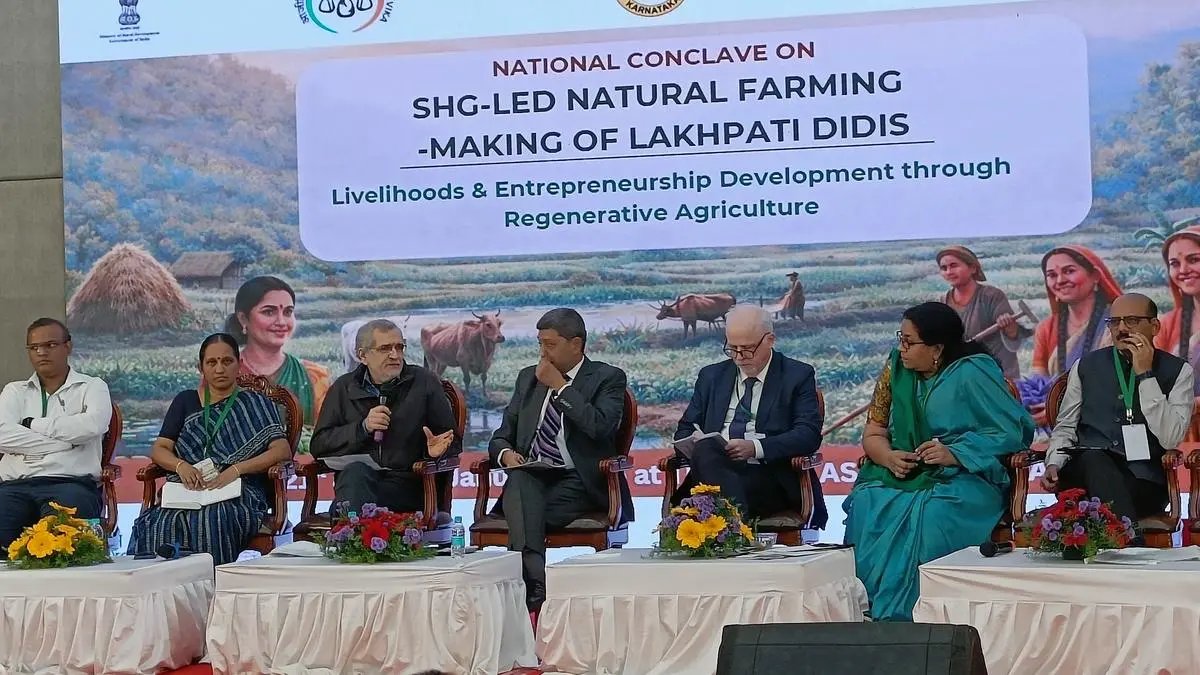

Experts speaking at a panel on National Policy Pathways for Regenerative Agriculture at National Conclave on SHG led natural farming in Bengaluru
India needs a gradual shift away from chemical-intensive farming, with policy reforms that expand farmers’ choice, experts said, as subsidies and extension systems continue to favour chemical inputs.
“What we need is a progressive movement away from chemical farming at the appropriate pace,” said Mihir Shah, Chairperson, National Coalition for Natural Farming.
Participating in a panel discussion at National Conclave on SHG-led Natural Farming, Shah said the core issue that policy must recognise is that farmers today do not truly have a choice. The entire agricultural ecosystem — subsidies, extension services, and research and development — has been structured around chemical-based farming. As a result, farmers are effectively pushed into one model of agriculture, without viable alternatives, Shah said.
While emphasis is being placed on natural farming and organic farming, the focus should be on integrating traditional knowledge with modern science to expand the options available to farmers, he said.
Further, Shah pointed out that India spends over ₹2.5 lakh crore on chemical fertiliser subsidies. Even redirecting 5 per cent of this amount towards bio-inputs and natural farming infrastructure could transform rural livelihoods, he said.
Natural farming is also about crop diversification, moving away from monocultures encouraged since the Green Revolution. Encouraging millets, pulses, oilseeds, and indigenous crops, as seen in initiatives by Karnataka and Odisha, can strengthen food security while advancing sustainable agriculture, Shah added.
Parashram Patil, Advisor, Viksit Maharashtra 2047, said that the time for natural farming has decisively arrived. If India aspires to become a developed economy by 2047, farmers must be brought to the centre of the economic transformation. Natural farming emerges as a critical strategy in this transition, not merely as an alternative production system, but as a holistic economic model that lowers costs while restoring ecological and human health, he said.
Patil said Maharashtra is formulating a dedicated Natural Farming Policy with the objective of converting 2 per cent of its cultivated land, around 12 lakh hectares, covering nearly five lakh farmers. The proposed policy looks beyond production, taking natural farming towards the value chain model that emphasises traceability, third-party certification, market access, and branding, Patil added.
Ashok Dalwai, Chairman of Board of Governors of the Institute for Social and Economic Change (ISEC), said India must move away from linear thinking in agriculture, which has repeatedly led to missed opportunities. The Green Revolution was a linear response to food shortages, and today’s debates on alternative technologies and farming risk repeating the same mistake. What is required instead is an ecosystem-based approach to agriculture, Dalwai said.
With the country’s population projected to reach 168 crore by 2050, agriculture cannot be viewed only from the point of production. It must ensure affordable and nutritious food for all, Dalwai said. Further, Dalwai said India’s goal of becoming a developed nation by 2047 depends not just on GDP growth, but on improving farmer livelihoods, reducing vulnerability and creating rural prosperity.
R Rengalakshmi, Executive Director, MS Swaminathan Research Foundation, observed that over the past two decades, men are moving to non-farm sectors while women are entering agriculture and skilling can support them to be a kind of decision-makers and also move away from the initial constraint of land ownership in accessing the productive resources and services. She also stressed the need for strengthening the community seed banks, which cater to the needs of small and marginal farmers.
A V Bhavani Shankar, CGM, NABARD, said the cash flows from natural farming would be distinctly different from the conventional production systems, which we intend to finance. It is outcome-based financing and there are instruments available, but they have to find a scale. “We at NABARD are trying to create some models, create a market for these, and then work. And a critical pathway which we would suggest is the digital, enabling digital ecosystem,” he added.
Published on January 22, 2026

