

Indian Govt is ‘close to approving’ GM mustard hybrid, says Solvent Extractors body chief

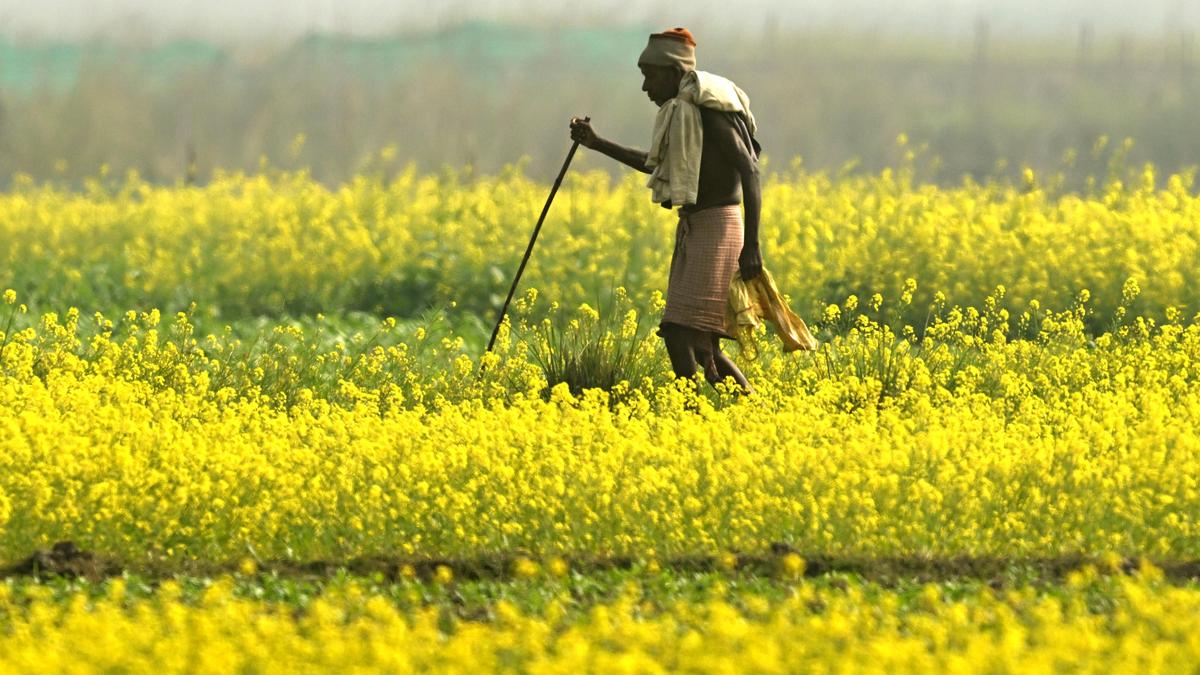
File Photo: A farmer inspects his mustard field in Guwahati, Assam on Thursday, 04 December 2025. Photo: The Hindu
| Photo Credit:
RITURAJ KONWAR
The Solvent Extractors’ Association of India (SEA) has said that the Indian government is reportedly close to approving a genetically modified (GM) mustard hybrid.
In his monthly letter to SEA members on Wednesday, Sanjeev Asthana, President of SEA, said such a move could mark a significant milestone in India’s agri-biotechnology policy.
The proposed approval follows extensive biosafety assessments and field trials, and is expected to focus on traits such as higher yields, improved disease tolerance and better oil recovery.
“If cleared, GM mustard could help address India’s long-standing productivity gap in oilseeds and reduce edible oil import dependence. The move also signals a cautious but progressive approach towards adopting advanced technologies to strengthen domestic oilseed production,” he said.
Soybean pricing scheme
Congratulating the Madhya Pradesh government for reintroducing the soybean ‘Bhavantar Bhugtan Yojana’ (BBY) for kharif 2025-26, he said this mechanism has once again created a win-win arrangement for farmers, industry and the government.
BBY is price deficiency payment scheme under which farmers are assured the declared minimum support price (MSP) for soybean without the Government resorting to physical procurement. Under the scheme, if prevailing mandi prices fall below the MSP the difference is directly credited to farmers’ Aadhaar-linked bank accounts through direct benefit transfer, ensuring timely income support.
He said farmers are protected against price distress and assured remunerative returns, while the processing industry is able to procure soybean at market-determined prices without supply disruptions or market distortions. At the same time, the Government avoids the logistical, storage and fiscal burdens associated with large-scale physical procurement.
Around 16 lakh tonnes (lt) of soybean have already been sold by farmers under the scheme as of December 2025, against the approved quantity of 22 lt by the Madhya Pradesh government, reflecting its wide acceptance and effective implementation. “The Bhavantar Yojana thus continues to serve as a balanced and efficient price support mechanism, stabilising farm incomes while supporting the soybean value chain,” Asthana said.
Climate resilient varieties
Mentioning that the Government has released 184 climate-resilient seed varieties across 25 crops, he said these varieties have been developed to offer higher productivity; tolerance to drought, heat or pests; and improved nutritional traits. The initiative supports the broader objective of climate-smart agriculture and aims to make improved seeds available to farmers over the next few seasons. This is expected to strengthen crop resilience and contribute to stable farm incomes, he said.
CPI revision
On the recent reports of the proposed revision of the CPI base year to 2024, he said this reflects changing consumption patterns. The key concern for edible oils is not the size of the food basket but whether the weightage within it accurately mirrors current consumption realities.
As SEA of India has earlier highlighted in its representation on WPI revision, edible oil consumption has seen significant internal shifts with some oils gaining prominence and others declining. “Even with a lower food weight, a data-driven rebalancing of individual edible oil weightage is essential to ensure realistic inflation measurement and fair representation of farmers, consumers and the industry,” he said.
Budget
On the upcoming Indian budget, he said a ₹1.22 lakh crore allocation was made for agriculture in the previous budget. The sector anticipates higher, targeted investments in technology-led and climate-resilient farming. This includes rollout of enhanced Kisan Credit Card limits, missions on high-yielding seeds and cotton productivity, Agristack digital infrastructure, and greater support for irrigation, research and development, and allied value chains.
He said the Government is also considering over ₹1 lakh crore additional allocation spread over five years to expand the Agriculture Infrastructure Fund, strengthening warehouses, cold chains, processing units, and logistics.
Together, these measures aim to modernize value chains, reduce post-harvest losses, improve market access and prices, and boost sustainable growth across the agriculture and food ecosystem, he added.
Published on January 21, 2026

