

Commerce Minister meets US envoy, US Senator to discuss bilateral issues
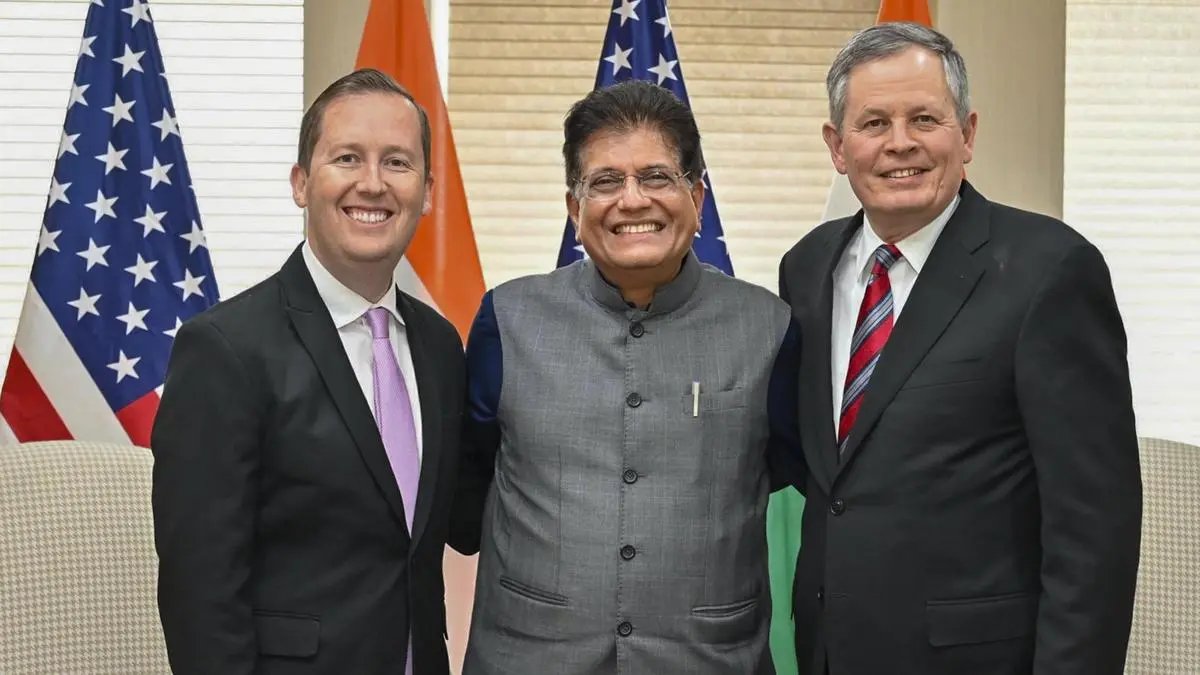

Union Minister of Commerce and Industry Piyush Goyal with US Senator Steve Daines and US Ambassador to India Sergio Gor during a meeting.
Commerce Minister Piyush Goyal met US Ambassador to India Sergio Gor and US Senator Steve Daines in Delhi on Monday and “exchanged views on bilateral relations” amid concerns raised by Daines on India’s import tariffs on pulses.
The meeting is significant as talks on the India-US bilateral trade agreement have now resumed virtually after the New Year break and both sides are attempting to iron out thorny issues, which include market access for agriculture.
Daines, who represents the US State of Montana, and Kevin Cramer, US Senator from North Dakota, recently wrote to Trump stating that there should be a push for “favourable pulse crop provisions” in any agreement the US signs with India.
“Delighted to again meet my good friends US Senator Steve Daines and the US Ambassador to India Sergio Gor. Had a productive exchange of views on our bilateral relationship,” Goyal posted on social media platform `X’ on Monday.
Daines, who is visiting India, also met External Affairs Minister S Jaishankar on Sunday for a “wide-ranging and open discussion” on India-US bilateral relationship and its strategic significance.
Import duty
In their letter to Trump on January 16, Daines and Cramer pointed out that India implemented a higher import duty of 30 per cent on yellow peas on November 1, 2025. “As a result of the unfair Indian tariffs, US pulse crop producers face a significant competitive disadvantage when exporting their high-quality product to India,” the letter noted.
North Dakota and Montana are the top two producers of pulse crops, including peas, and India is the world’s largest consumer of these crops, contributing to approximately 27 per cent of the world’s consumption, it observed.
“Engaging Prime Minister Modi on pulse crop tariffs to enhance the economic cooperation between our countries would be mutually beneficial to both American producers and Indian customers,” they said.
The US has also been pushing India to give market access to its soya and corn as part of the BTA. However, India has been hesitating as most of the soya and corn grown in the US is of the genetically modified (GM) variety, which is banned in India.
It is important for India to strike a trade deal with the US as it is facing 50 per cent tariffs on most of its exports but there are “red lines” that New Delhi is not willing to cross, that include protection of sensitive agriculture and dairy commodities.
Published on January 19, 2026

