

Passive Euthanasia in India: Law, Courts, and the Struggle to Die with Dignity
Thirty-one-year-old Harish Rana’s frail figure, as he lies motionless in bed in his family’s Ghaziabad home near Delhi, bears little resemblance to the handsome, athletic youngster that he once was. His eyes are open, but do not register anything. He does not recognise anyone. He cannot speak or hear and breathes through a tracheostomy tube.
Harish is fed a diet of protein shake and mashed and filtered pulses through a feeding tube, which has to be replaced periodically. His position has to be changed every two hours so that the bedsores caused by his immobile condition do not get worse.
In 2013, when he was a student of civil engineering at Punjab University, Harish suffered a fall from the fourth floor of the house in Mohali where he lived as a paying guest. The accident left him with severe head injuries. For the last 13 years, he has been confined to his bed, paralysed, unresponsive and dependent on caregivers for survival.
After years of watching him gradually wither away, Harish’s parents took the painful decision of seeking a peaceful exit for their son. The story of Harish and his family is as much about a promising young life that has come to a standstill due to an unfortunate accident as it is about a mother and father having to make the cruel choice between keeping their son alive in a vegetative state or letting him go.
Harish’s parents moved the Delhi High Court in July 2024 seeking passive euthanasia for him. But the High Court dismissed their petition, holding that the case did not fall within the ambit of passive euthanasia because he was not kept alive “mechanically”, meaning he was not on ventilator support.
Subsequently, they went to the Supreme Court, which in August 2024 upheld the High Court’s decision. On his last working day on November 26, 2024, Chief Justice of India D.Y. Chandrachud passed an order directing the Uttar Pradesh government to help the family with the facilities needed for Harish’s home care and provide him with medicines and consumables free of cost.
However, with Harish’s condition worsening, the family approached the Supreme Court again in November 2025. This time, the court heeded their plea to set in motion the process to assess Harish’s eligibility for passive euthanasia. For the first time since its 2018 judgment legalising passive euthanasia and laying down guidelines for it, the court activated the process in an individual case.
In the court-mandated interactions that Harish’s family had with the lawyers handling the case, his father, Ashok Rana, said their son no longer had a voice of his own and therefore he and his wife believed it was their responsibility to speak for him. His mother, Nirmala Devi, said the family had tried everything within their means to help their son, but there was no improvement in his condition. She spoke of the pain of watching her son suffer without being able to alleviate the suffering. The couple also expressed their concern about what would happen to their son after their passing.
Harish’s father, who is 63 years’ old, worked as a chef with Taj SATS Air Catering. His mother, who is his primary caregiver, is 58.
The family is from Kangra district in Himachal Pradesh. Harish and his two siblings were born and brought up in Delhi. The family earlier lived in Dwarka area in southwest Delhi but shifted to Ghaziabad in September 2021 because the previous residence did not have enough sunlight and the access road was too narrow for ambulances to reach their doorstep comfortably.
An undated photograph of Aruna Shanbaug.
| Photo Credit:
AFP
Ashok Rana, who retired in February 2022, now sells sandwiches at cricket grounds near his house; he needs the money to meet the family’s expenses. Harish’s siblings pitch in, too. His younger brother, Ashish, 28, recently started working as a programme manager with a Gurgaon-based firm. His sister, Bhawana, who is married and lives nearby, works in a bank.
Harish’s father told the legal team that while government authorities have been helpful, the family has continuously faced practical difficulties in arranging day-to-day medical care and accessing emergency medical support. Skilled caregivers are also not easily available.
The Rana family holds on to memories of Harish as an energetic and physically active youngster who loved playing football and working out. The family’s lawyer, Manish Jain, said: “The family’s decision [to seek closure] does not come from a place of desperation or despair. They have, despite all their struggles, maintained a positive attitude. The decision is well-thought-out and comes from love and concern for Harish.”
Justices J.B. Pardiwala and K.V. Viswanathan, the two Supreme Court judges who heard the matter, met Harish’s parents and his younger brother on January 13. In their order written after meeting them, the judges said that the family might not be aware of the legal nuances involved in the case, but going by the reports filed by the Primary Medical Board and the Secondary Medical Board, which were constituted by the court to assess Harish’s eligibility for passive euthanasia, it was clear to them that there was no sign or hope of recovery for Harish.
“They believe that Harish is suffering like anything and he should be relieved of all further pain and suffering,” the judges noted.
The court has reserved its judgment in the case.
Both the Primary Medical Board and the Secondary Medical Board were of the opinion that continuation of medical treatment is not in the best interest of Harish and nature should be allowed to take its own course. The two panels concluded that Harish would remain in a permanent vegetative state for years and was unlikely to recover and live a normal life.
Harish’s case has put the focus on the framework governing passive euthanasia. An immediate outcome could be the expansion of the ambit of what constitutes passive euthanasia—not just switching off ventilator support but also withdrawal of clinically-assisted nutrition and hydration, which includes use of feeding tubes.
The Aruna Shanbaug case
In the absence of any laws regarding euthanasia passed by Parliament, the Supreme Court’s judgments provide the legal framework for it. Much before Harish, it was the case of Aruna Ramachandra Shanbaug, a nurse in Mumbai’s KEM Hospital, which drew judicial and public attention to the issue.
Shanbaug suffered irreversible brain damage during a brutal sexual assault by a sweeper on the premises of KEM Hospital in 1973. For the rest of her life, she lay bed-ridden in a vegetative state at KEM Hospital and was taken care of by the hospital’s medical and nursing staff. She died of pneumonia in May 2015.
Pinky Virani, the journalist who moved court to seek closure in the Aruna Shanbaug case.
| Photo Credit:
S. SUBRAMANIUM
In 2011, the journalist Pinki Virani, who had written a book on Shanbaug, moved the Supreme Court with a prayer that her feeding should be stopped in order to allow her to die peacefully. The court dismissed the petition but recognised the legality of passive euthanasia. It stated that passive euthanasia could be allowed in certain cases but with the approval of the High Court.
2018 judgment legalising passive euthanasia
In 2018, acting on a petition filed by the NGO Common Cause, the Supreme Court legalised passive euthanasia. Recognising right to die with dignity to be an integral part of the right to life under the Constitution, the court laid down an elaborate multi-tier process to decide cases. Crucially, the judgment drew a distinction between active and passive euthanasia. A positive affirmative act that could cause death would constitute active euthanasia. Withdrawal of life support measures or withholding of medical treatment aimed at artificially prolonging life would constitute passive euthanasia. The court made it clear that active euthanasia could be made legal only by Parliament.
Passive euthanasia: Where we are and how we reached here
1966: Gian Kaur vs State of Punjab. The Supreme Court rejects the plea to include “right to die” in Article 21 of the Constitution. The court says that any aspect of life which makes it dignified may be read into the “right to life” under Article 21, but not that which extinguishes it. It says the “right to die” is inherently inconsistent with the “right to life” as is “death” with “life”.
2011: Aruna Ramachandra Shanbaug vs Union of India. The Supreme Court does not permit passive euthanasia for Aruna Shanbaug. However, the court lays down the difference between active and passive euthanasia. It also says passive euthanasia should be permitted in certain situations with the approval of the High Court.
2018: Common Cause vs Union of India. The Supreme Court recognises the right to die with dignity as an integral part of the right to life and lays down guidelines and procedure for passive euthanasia, also recognising the legality of advance medical directive (AMD), or living will.
2023: The Supreme Court simplifies passive euthanasia guidelines.
2024: Union Ministry of Health and Family Welfare comes out with guidelines for withdrawal of life support for terminally ill patients in keeping with the legal principles outlined by the Supreme Court.
The procedure as outlined by the Supreme Court with regard to decisions on end-of-life care:
Scenario 1. A patient with decision-making capacity can seek withholding or withdrawal of life-sustaining treatment, and the doctor abides by the wish of the patient.
Scenario 2. When the patient does not have decision-making capacity and has prepared an AMD or a living will which details the circumstances in which life-supporting treatment should be either withheld or withdrawn.
Step 1. The treating physician shall ascertain the genuineness and authenticity of the AMD.
Step 2. The hospital sets up a Primary Medical Board (PMB), which decides on whether or not to withhold or withdraw treatment.
Step 3. The hospital sets up a Secondary Medical Board (SMB) which takes a final decision, either agreeing or disagreeing with the findings of the PMB.
Step 4. If the SMB recommends passive euthanasia, the hospital informs the Judicial Magistrate First Class (JMFC) and life supporting treatment is withheld or withdrawn. If the SMB does not recommend passive euthanasia, the case can be referred to the High Court under Article 226; the court may set up an independent expert committee.
Scenario 3. When the patient does not have decision-making capacity and has not drawn up an AMD.
Step 1. The physician may inform the hospital, which in turn shall constitute a PMB which shall discuss the case with the next of kin/next friend/guardian of the patient, who may give the consent in writing and the PMB may certify the next course of action.
Step 2. If the PMB certifies the option of withdrawal or refusal of further treatment, the hospital shall constitute an SMB. If it does not recommend passive euthanasia, an application can be made to the High Court under Article 226.
Step 3. If the SMB agrees that passive euthanasia is the best course of action, the hospital informs the JMFC and life-supporting systems are either withheld or withdrawn. If the SMB does not recommend passive euthanasia, an application can be made to the High Court under Article 226.
The 2018 judgment required Primary and Secondary Medical Boards to be set up to decide on applications of passive euthanasia. The judgment recognised the legality of an “advance medical directive” or a “living will”, which individuals could draw up to declare refusal/direct withdrawal of treatment in an end-of-life scenario, and prescribed a process for individuals to prepare this document.
In 2023, the Supreme Court passed an order simplifying the procedure, which was proving to be impractical and unworkable. The 2018 guidelines required the living will to be executed in the presence of a Judicial Magistrate First Class (JFMC). Under the 2023 order, a living will is only required to be attested before a notary or a gazetted officer. Whereas the 2018 judgment required doctors with specialisations and with at least 20 years’ experience to be part of the medical boards constituted to assess the patient’s condition, the 2023 order allows doctors with five years’ experience to be taken on the panels. It also did away with the requirement of acquiring a JMFC’s approval for withholding or withdrawing life support.
Harish Rana’s case: A turning point?
Harish’s case is now turning out to be a test case for the guidelines for passive euthanasia. The arguments in the case in the Supreme Court involved a discussion about making available the necessary medical and administrative framework on the ground. Experts point out that only a few State governments have taken steps to put in place the necessary framework, such as forming panels of registered medical practitioners for appointment as members of Secondary Medical Boards.
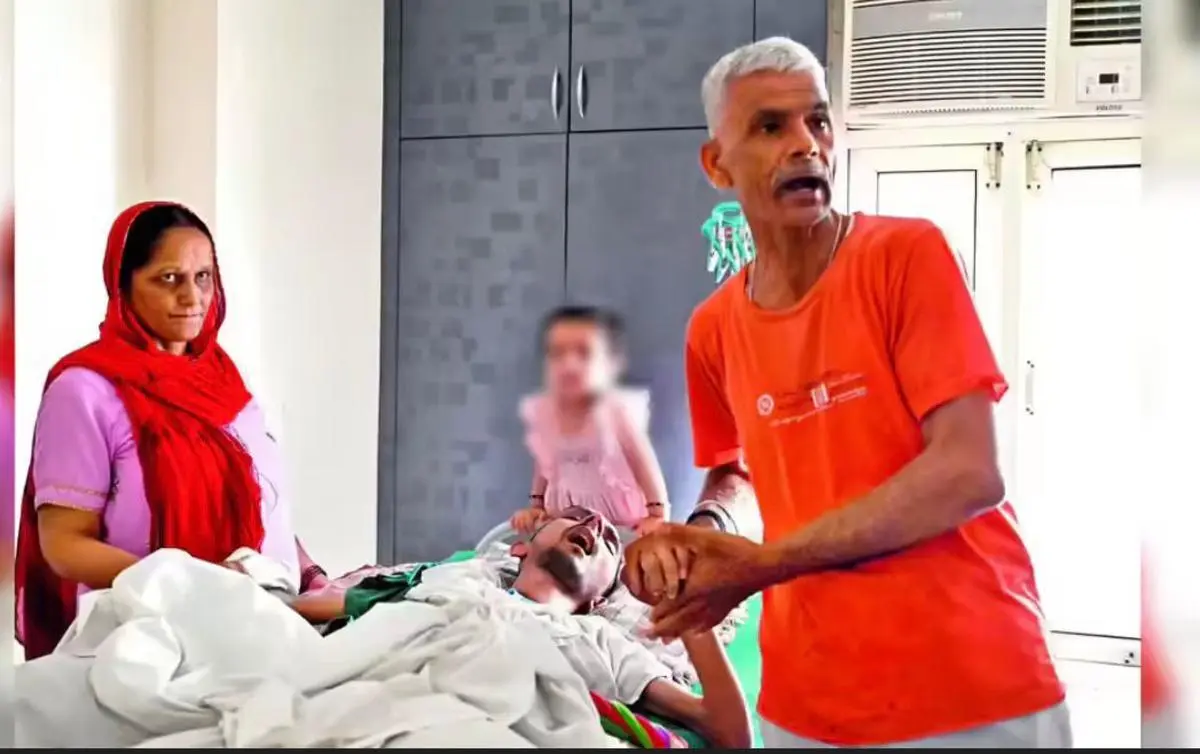
Harish Rana, who became paralysed after an accident in 2013, is cared for by his family at home.
| Photo Credit:
BY SPECIAL ARRANGEMENT
Shortly after the 2023 order revising the guidelines, the Mumbai-based gynaecologist and obstetrician Dr Nikhil Datar prepared a living will, probably the first to do so in accordance with the norms laid down in the 2023 order. However, he realised that the State government had not appointed custodians to receive living wills. He also discovered that the State did not have a panel of registered medical practitioners as a pool for the Chief Medical Officer to draw from when setting up Secondary Medical Boards.
Dr Datar filed a public interest litigation (PIL) in the Bombay High Court in 2024 seeking implementation of the Supreme Court’s guidelines on facilitating passive euthanasia. Subsequent to the petition, the State government appointed 417 officials in local bodies to receive and manage living wills.
However, according to Dr Datar, the system continues to suffer from several procedural gaps. There is no clarity on where the living wills should be stored so that they can be retrieved and verified at a later date. His PIL plea has sought creation of a digital database to store living wills.
“The National Medical Commission is yet to make necessary changes in the Code of Medical Ethics to take into account the provision for passive euthanasia. The pace at which things are moving, one cannot expect a meaningful implementation of the court order,” he said.
In simplifying the guidelines, the court had acted on the plea of the Indian Society of Critical Care Medicine(ISCCM). Dr Srinivas Samavedam, president of the ISCCM, said he has beenreaching out to State governments on implementing the court order. He has also travelled to States to meet the officials concerned. “Last year, we sent physical copies of the Supreme Court judgment accompanied by a letter to the health secretaries of all the States with regard to implementation of the court order. However, we did not get even one response. A lot has to be done in terms of creating administrative awareness and acceptance,” he said.
“There is a streamlined process in place in Karnataka,” Dr Samavedam added. “It is work in progress in Kerala. The Odisha government has taken some initiative in this direction.”
The multi-tier system for approval for passive euthanasia applications was created because of apprehensions of possible misuse. But the process, despite the 2023 modifications, apparently remains cumbersome and not adequately sensitive to the needs of the patient and his or her family.
Dr M.R. Rajagopal, Chairman Emeritus, Pallium India, has prepared a living will. “I have stated clearly [in the advance medical directive] that in the scenario where I am unlikely to come back to a reasonable quality of life, I should not be subjected to aggressive treatment modalities. I should instead be offered palliative care so that I can go in peace. However, in the present system, I will be stuck alone in ICU and I will see only masked creatures around me. My family will not be by my side as they run around getting approvals from the medical boards,” he said.
Social response to passive euthanasia
Social response to the issue is uneasy, with questions of morality, ethics, and religious belief playing on people’s minds. Dr Surendra Dhelia, joint secretary of the Society for the Right to Die with Dignity, said cases like that of Shanbaug or Harish force people to come to terms with the complex subject.

Harish Rana, before the 2013 accident changed his life.
| Photo Credit:
BY SPECIAL ARRANGEMENT
Dr Dhelia said: “We, as a society, continue to be uneasy with the idea of allowing a person to pass on. I am reminded of a TV debate I participated in after the Supreme Court refused to allow passive euthanasia for Shanbaug. I spoke in favour of euthanasia. Some panellists spoke against euthanasia. However, when they were asked what they would do if they were in the same state as Shanbaug, their answer changed.”
According to Dr Rajagopal, the country’s medical system is insensitive to human suffering and misinterprets a “beating heart” as “life”. “Life is much more than just a beating heart. This is the reason why the issue is before the court. I hope the court listens to enough people who have suffered, whose kin have suffered. I hope the importance of palliative care is emphasised upon,” he said. He pointed out that whereas in Europe withdrawal of artificial life support takes place in 90 per cent of cases in end-of-life scenario, the figure stands at 30 per cent in India.
Active euthanasia and passive euthanasia
There is also the issue of the tenuous difference between “active” and “passive” euthanasia. In Harish’s case, the Delhi High Court and the Supreme Court were of the view that withdrawing the feeding tube would amount to active euthanasia.
Just two days after the Supreme Court gave its verdict in 2018, the Bioethics Unit of the Indian Council of Medical Research came out with a publication on “Definition of terms used in limitation of treatment and providing palliative care at end of life”. The document stated that “the term passive euthanasia is an obsolete terminology and should be avoided as euthanasia cannot be passive and withholding or withdrawing a potentially inappropriate treatment in a patient dying with a terminal illness that only prolongs the dying process, cannot be construed as an intention to kill”. The report noted that in medically advanced countries, the term is avoided because of its problematic connotations, and “withholding or withdrawing life-sustaining treatment, if done under appropriate circumstances” is ethically and legally acceptable.
Views are divided on whether “active euthanasia”, as defined by the court, should be allowed. While some experts say it is the humane thing to do in cases where the patient is going through unbearable pain and suffering, others urge caution.
Dr Dhelia said: “It should be looked at as an option for patients who are terminally ill. In such cases, active voluntary euthanasia should be allowed. I am using each word here very carefully: ‘active voluntary euthanasia’, where a patient who is terminally ill, while continuing to be in his or her senses, expresses the wish that treatment be stopped and he or she is allowed to pass on. The Society for the Right to Die with Dignity has demanded a legislation for this.”
Dr Samavedam said given the socio-economic realities in India, it is not advisable. “As much as 30-40 per cent of India’s population pays for healthcare from their pocket. More than 60 per cent of the population relies on private healthcare. One critical illness is enough to push a family below the poverty line. In such a scenario, vulnerable members of the family can be left to die. This is also the reason why we have a multi-tier process for passive euthanasia,” he said.
Dr Rajagopal said: “My short answer is: yes, but not now. I am not saying India can legalise active euthanasia. India can consider it, but not now.”
He added: “Most of the countries which have legalised euthanasia have provided for palliative care. We must make a provision for palliative care, which is in the National Health Policy since 2017 and has been included in the medical and nursing curricula. But pain relief reaches only 4 per cent of the population. Until it is provided to the remaining 1.4 billion people in our country, we don’t have the moral and ethical right to talk about it.”
Also Read | ‘It is a person’s right’
Also Read | I refused to let circumstances define my creative destiny: Syed Saleem

