


Economists pitch for recalibrating public capex to avoid crowding out of private investment
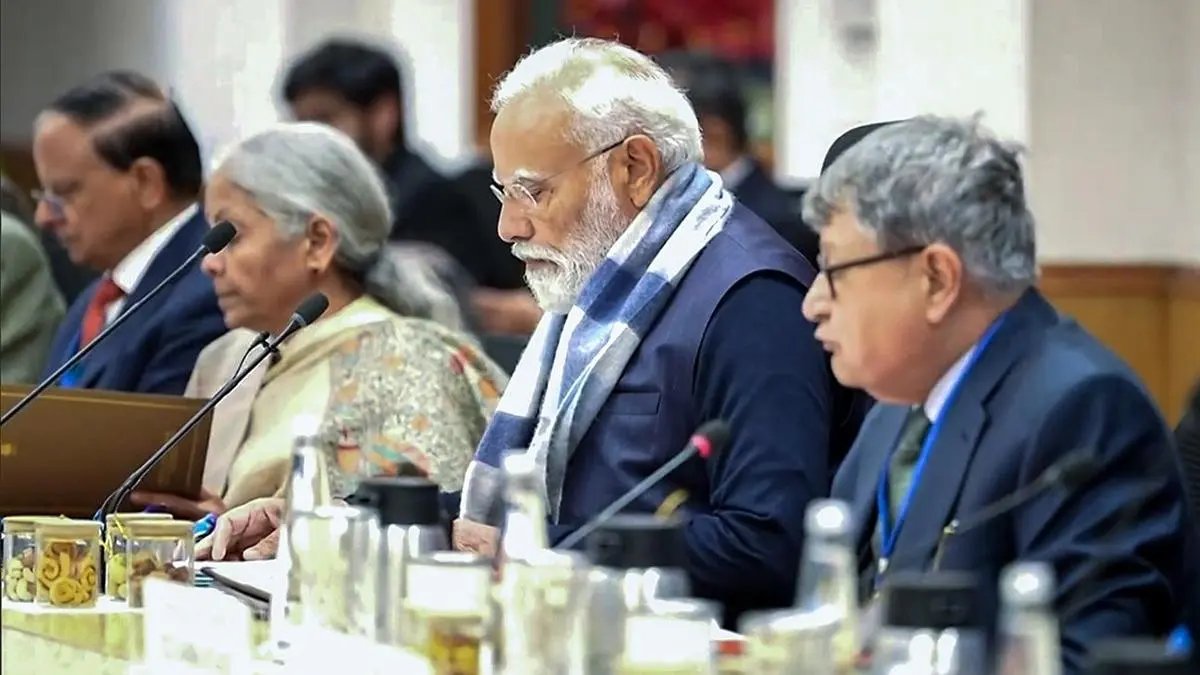

Prime Minister Narendra Modi chairs a meeting with economists at NITI Aayog, in New Delhi on Tuesday. (PMO Youtube/ANI Video Grab)
| Photo Credit:
ANI
Amidst Prime Minister Narendra Modi’s call for policymaking and budgeting to remain anchored with vision for 2047, economists on Tuesday advocated for lowering capital expenditure by the government to check crowding out private investment.
Modi met economists to get their views for the forthcoming Union Budget, which is likely to be presented on February 1 next year. The Theme of the interaction was ‘Aatmanirbharta and Structural Transformation: Agenda for Viksit Bharat’. It was also attended by Finance Minister Nirmala Sitharaman, NITI Aayog Vice-Chairman Suman Bery, NITI Aayog CEO BVR Subrahmanyamm besides economists such as Ashok K Bhattacharya, N R Bhanumurthy, Rajani Sinha, Madan Sabnavis, Dharmakirti Joshi, Rahul Bajoria and Monika Halan beside others.
Sources said that during the meeting some of the economists called for bringing government capital expenditure closer to 3 per cent to avoid ‘crowding out’ private investment. Higher spending by the government means more borrowing by it and thus less money available for the private sector and that too at higher cost.
The Budget for FY 2025-26 allocates ₹11.21 lakh crore (3.1 per cent of GDP) towards capital expenditure. It includes capital support to States through interest free long-term loans with an outlay of ₹1.50 lakh crore. Also, allocation under Grants-in-aid for creation of capital assets is projected at ₹4.27 lakh crore (or 1.2 per cent of GDP). Thus, the effective capital expenditure in FY 2025-26 is estimated at ₹15.48 lakh crore (or 4.3 per cent of GDP).
Meanwhile, according to sources, economists also flagged decline in household financial savings. Their concerns were weakening domestic savings could constrain financing options for both the government and the private sector. Lower savings along with uncertain foreign capital flow posing challenge to finance current account deficit, economists said.
Viksit Bharat
Earlier, in his address, Modi pressed the need for mission-mode reforms across diverse sectors to sustain long-term growth to achieve the vision of Viksit Bharat by 2047. He also made a case for building world- class capabilities and attaining global integration.
Speaking about Viksit Bharat as a national aspiration, he said the vision of a developed India by 2047 has transcended government policy to become a genuine mass aspiration, an official statement said. It mentioned that the participants also noted that the unprecedented flurry of cross sectoral reforms in 2025, and their further consolidation in the coming year, will ensure that India continues to chart its path as one of the fastest growing global economies by strengthening its foundations and unlocking newer opportunities.
The discussion focused on accelerating structural transformation through increased household savings, robust infrastructure development, and the adoption of cutting-edge technology. The group explored the role of artificial Intelligence as an enabler of cross-sectoral productivity and also discussed the continued scaling of India’s Digital Public Infrastructure (DPI).
Published on December 30, 2025

