









How Neuro-Symbolic AI Could Transform Anti-Money Laundering Compliance
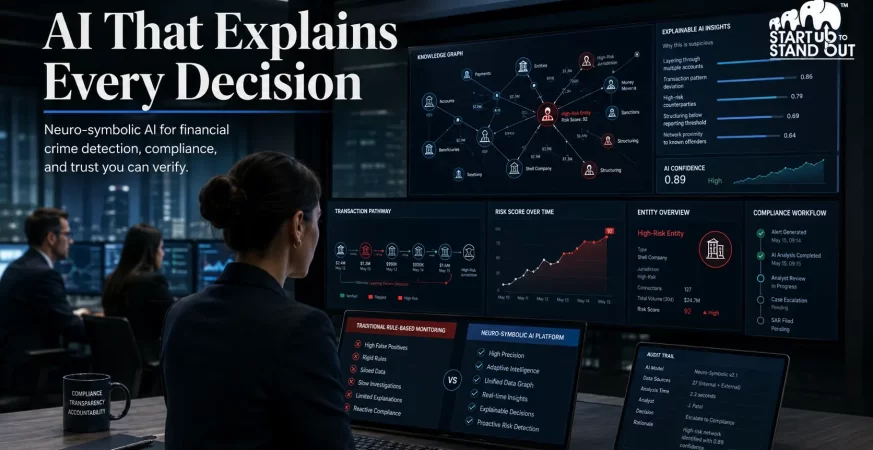
How Neuro-Symbolic AI Could Transform Anti-Money Laundering Compliance Introduction Financial crime has become a technology problem. As banking systems become increasingly digital, interconnected, and global, money laundering networks are evolving just as quickly. Criminal organizations now leverage complex transaction chains, shell entities, and cross-border financial pathways to hide illicit funds from regulators and financial institutions. The challenge for banks is enormous. They must identify suspicious activity across millions of transactions while maintaining regulatory compliance and avoiding disruptions for legitimate customers. Existing Anti-Money Laundering (AML) systems often struggle to balance these competing objectives. Traditional rule-based systems generate overwhelming volumes of false alerts, while modern AI models frequently operate as opaque “black boxes” that regulators cannot easily trust. Team PADAMDURG’s Neuro-Symbolic AI-Based Explainable Fraud Detection System proposes a new path forward by combining the predictive power of artificial intelligence with the transparency of symbolic reasoning. The Growing Cost of Financial Crime Money laundering remains one of the largest challenges facing global financial institutions. Criminal networks continuously adapt their techniques to evade detection by: Using shell companies Splitting transactions into smaller amounts Moving funds across multiple jurisdictions Leveraging digital financial channels Exploiting gaps between regulatory systems The scale of the problem has forced regulators worldwide to strengthen compliance requirements and increase scrutiny on financial institutions. Banks now face enormous pressure to detect suspicious activity while maintaining efficient customer experiences. Why Traditional AML Systems Are Struggling For decades, most AML systems have relied on rule-based architectures. These systems flag transactions based on predefined criteria such as: Large transfers High-risk jurisdictions Unusual transaction volumes Specific behavioral patterns While easy to understand and audit, these systems suffer from a major weakness: rigidity. Financial criminals quickly adapt to known thresholds and adjust their behavior accordingly. To compensate, organizations continuously add more rules. Over time, this creates increasingly complex systems that generate excessive false positives and overwhelm compliance teams. In many institutions, the majority of flagged transactions ultimately prove to be legitimate. The Promise and Problem of Artificial Intelligence Machine learning appeared to offer a solution. Unlike static rule engines, deep learning models can identify complex behavioral patterns hidden within massive transaction datasets. Benefits include: Improved detection accuracy Identification of subtle anomalies Better recognition of emerging fraud patterns Reduced false positives However, deep learning introduces a new challenge. Most advanced neural networks cannot explain how they reach their conclusions. This creates the well-known black box problem. A model may accurately flag a suspicious transaction, but regulators, auditors, and compliance officers often require clear justification for why a decision was made. In heavily regulated industries, unexplained decisions can become a significant liability. The Rise of Neuro-Symbolic AI Neuro-symbolic AI aims to combine the strengths of both approaches. Rather than choosing between accuracy and transparency, it integrates them. The architecture consists of two complementary layers: Neural Intelligence Advanced machine learning models analyze transaction data and identify complex behavioral patterns. These systems include: Recurrent Neural Networks (RNNs) Graph Neural Networks (GNNs) Pattern recognition engines Their role is to detect suspicious activity that traditional rules may miss. Symbolic Reasoning A symbolic logic engine evaluates findings using: Regulatory rules Compliance policies Knowledge graphs Logical constraints This layer transforms statistical predictions into transparent reasoning that humans can understand and audit. Why Knowledge Graphs Matter One of the most powerful aspects of the system is its use of knowledge graphs. Instead of analyzing transactions in isolation, the platform maps relationships between: Individuals Accounts Organizations Transaction pathways This creates a contextual view of financial behavior. By understanding how entities interact over time, the system can uncover suspicious networks that would remain invisible through conventional transaction monitoring methods. Knowledge graphs also improve explainability by visually demonstrating how risk propagates through connected entities. Making AI Decisions Explainable The defining feature of the platform is explainability. When a suspicious transaction is identified, the system generates a detailed reasoning trail. Rather than presenting a simple risk score, compliance teams receive: Violated regulatory rules Relevant transaction patterns Connected account relationships Contributing risk factors Human-readable explanations The platform incorporates Explainable AI (XAI) frameworks such as SHAP and LIME to translate neural network outputs into understandable insights. This enables regulators, auditors, and investigators to understand exactly why an alert was generated. A Scalable Business Model for Modern Banking Beyond technology, the proposal outlines a scalable software platform model. The solution operates through cloud infrastructure capable of processing millions of transactions without disrupting banking operations. Potential customers include: Tier-1 banks Digital banks FinTech platforms Payment processors Financial regulators Revenue opportunities can include: SaaS subscriptions Enterprise licensing Compliance platform integrations Advanced analytics modules Consulting and deployment services This creates a recurring revenue structure aligned with long-term compliance requirements. Strategic Advantages Several trends strengthen the long-term opportunity for neuro-symbolic AML systems. Increasing Regulation Financial institutions face growing compliance obligations globally. Rising Fraud Complexity Traditional rule systems struggle to adapt to sophisticated laundering networks. Demand for Explainability Regulators increasingly require transparency in AI decision-making. Growth of Digital Banking The expansion of digital payments creates larger datasets and greater demand for automated monitoring. These factors create favorable conditions for explainable AI platforms that balance innovation with accountability. Insights & Analysis The most significant innovation is not artificial intelligence itself. Banks already use AI. The real breakthrough is explainable intelligence. For years, financial institutions have been forced to choose between: Transparent but inefficient rule systems Powerful but opaque machine learning models Neuro-symbolic AI removes that trade-off. By combining statistical learning with structured reasoning, the technology delivers both predictive performance and regulatory accountability. This may ultimately become the preferred architecture not only for AML systems but for many high-stakes industries where decisions must be both accurate and explainable. Conclusion The future of fraud prevention requires more than better algorithms. It requires trust. Financial institutions need systems capable of detecting increasingly sophisticated criminal activity while remaining transparent enough to satisfy regulators, auditors, and customers. Team PADAMDURG’s Neuro-Symbolic AI-Based Explainable Fraud Detection System offers a compelling solution by combining machine learning, symbolic logic, knowledge graphs, and explainable AI into a single
manjula
- June 23, 2026
- 0 Comments
- 204 Views
-
