









How Subscription-Based Learning Platforms Could Democratize Quality Education
Introduction
The internet has made educational content abundant.
Yet for millions of students, learning has become more fragmented than ever.
Notes are scattered across Telegram groups. Video lectures are spread across YouTube playlists. Previous Year Questions (PYQs) exist on dozens of unrelated websites. Coaching materials remain locked behind expensive paywalls, while university-specific resources are often incomplete or outdated.
The problem is no longer access to information.
It is access to the right information.
Students frequently spend hours searching for reliable study material instead of actually studying. This challenge is particularly severe for learners in Tier-2 and Tier-3 cities, where access to premium coaching institutions remains limited.
A subscription-based study materials platform aims to solve this challenge by bringing verified academic resources, AI-powered personalization, practice tools, and collaborative learning into one integrated ecosystem. Instead of forcing students to navigate multiple disconnected platforms, it offers a single destination designed around how modern learners actually study.
The Problem Isn’t Content—It’s Fragmentation
India now has one of the world’s largest higher education ecosystems, yet students continue to struggle with finding structured academic resources.
Current challenges include:
- Study material scattered across multiple platforms
- Expensive coaching notes and test series
- Content that doesn’t align with university syllabi
- Difficulty identifying trustworthy resources
- Unequal access between urban and rural students
Ironically, the internet offers more educational content than ever before, but its fragmented nature often creates confusion rather than clarity.
The result is wasted time, inconsistent preparation, and unequal learning opportunities.
A Centralized Learning Ecosystem
The proposed platform shifts the focus from content creation to content integration.
Instead of producing isolated educational resources, it aggregates high-quality academic material into a structured subscription platform.
Students gain access to:
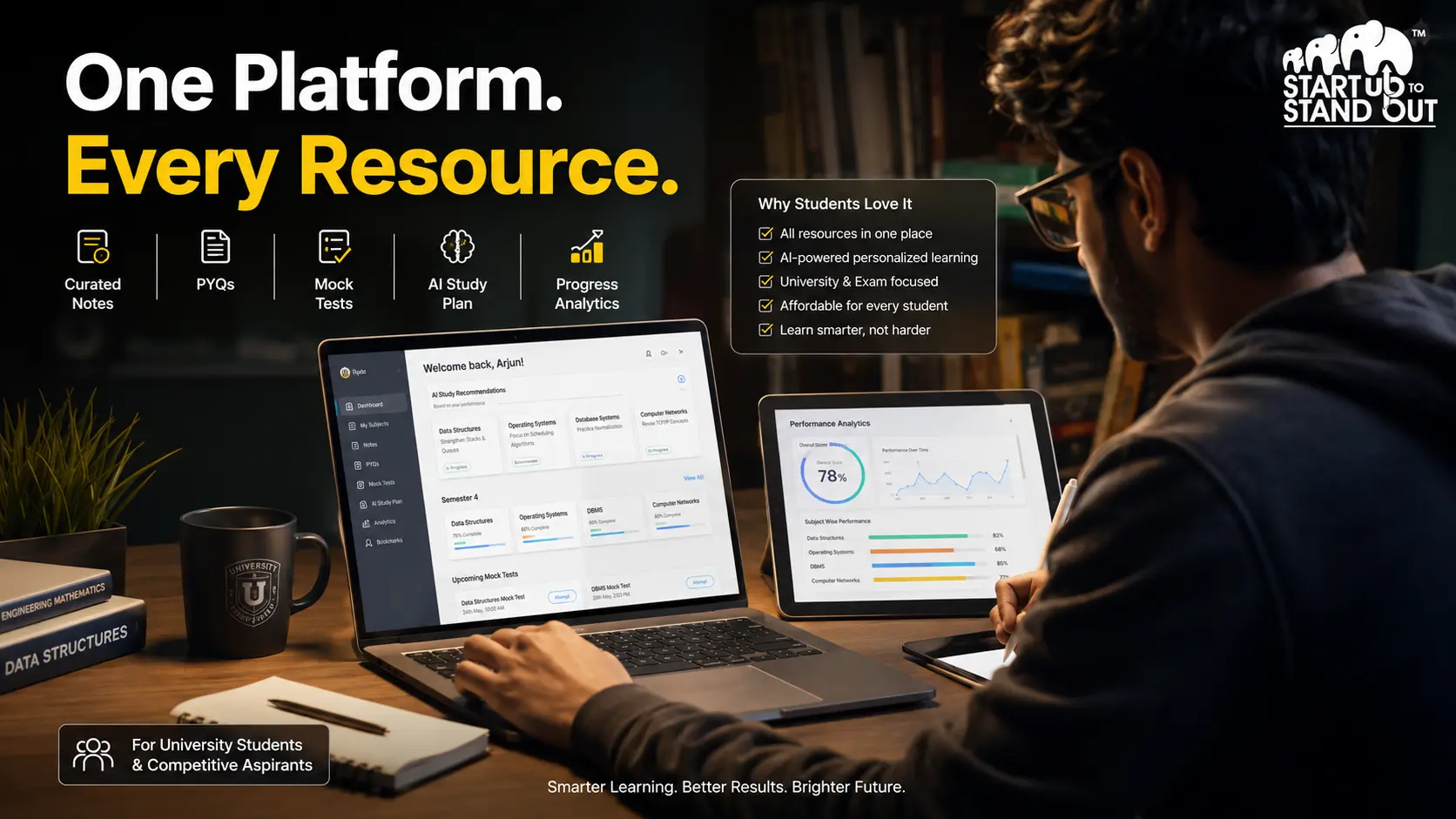
Curated Notes
Verified subject-wise notes prepared with support from professors and academic toppers.
Previous Year Questions (PYQs)
Organized by university, semester, subject, and examination pattern.
Mock Tests
Practice assessments designed to improve examination readiness.
Doubt Resolution
Interactive peer and expert support through text and video-based discussions.
AI-Powered Recommendations
Personalized study suggestions based on:
- Academic profile
- Learning progress
- Target examinations
- Subject performance
Rather than overwhelming learners with endless content, the platform helps them focus on what matters most.
Making Learning More Personalized
One of the platform’s strongest differentiators is its AI recommendation engine.
After students create an academic profile, the system analyzes factors such as:
- University
- Semester
- Target examinations
- Subject preferences
- Learning pace
Based on this information, the platform recommends:
- Priority chapters
- Practice tests
- Revision plans
- High-value PYQs
- Personalized study paths
This transforms learning from a one-size-fits-all experience into a guided academic journey.
Why Freemium Works in Education
The platform adopts a freemium business model.
Students receive free access to essential resources before upgrading to premium plans for advanced features.
Premium subscriptions unlock:
- Complete PYQ libraries
- Full mock test series
- AI-driven recommendations
- Live doubt-solving
- Advanced analytics
This strategy lowers adoption barriers while allowing students to experience the platform’s value before making financial commitments.
Building an Ecosystem Around Collaboration
Content quality is central to educational platforms.
Instead of relying solely on internal teams, the platform collaborates with:
- Professors
- Subject experts
- Academic toppers
- Student creators
- Universities
This collaborative model continuously expands the content library while maintaining academic relevance and syllabus alignment.
Students benefit from both institutional expertise and peer-generated insights.
A Diversified Business Model
The proposal outlines multiple revenue streams that support long-term sustainability.
Subscription Plans
Monthly and annual memberships serve as the primary revenue source.
Premium Content Bundles
Crash courses, specialized test series, and advanced preparation material.
Institutional Licensing
Universities and coaching institutes can purchase bulk access for students.
Affiliate Partnerships
Collaborations with educational brands, publishers, and online learning providers.
Advertising
Limited advertising within the free tier generates additional revenue without compromising user experience.
This diversified approach reduces reliance on a single monetization channel while supporting scalability.
Strong Network Effects
As more students join the platform, its value increases.
More users create:
- Better content ratings
- Richer learning data
- Improved AI recommendations
- Stronger peer learning communities
At the same time, increased participation attracts more educators and academic contributors.
This creates a self-reinforcing ecosystem where every new participant improves the experience for everyone else.
Such network effects are among the strongest competitive advantages available to digital platforms.
Challenges the Platform Must Overcome
Despite its strong value proposition, the platform faces several strategic challenges.
These include:
- Competition from established EdTech companies
- Students’ expectation that educational content should be free
- Maintaining content quality at scale
- Cold-start limitations for AI personalization
- Balancing creator incentives with affordability
Successfully addressing these issues will require continuous investment in content partnerships, user experience, and community trust.
Insights & Analysis
The most valuable asset of this platform is not its study notes.
Study notes already exist everywhere.
The real product is organization.
Students rarely struggle because information is unavailable.
They struggle because valuable information is scattered, inconsistent, and difficult to trust.
By integrating verified resources, AI personalization, collaborative learning, and syllabus-specific organization into one ecosystem, the platform transforms educational content into educational infrastructure.
Its greatest long-term competitive advantage may ultimately be its growing combination of curated academic content, user behavior data, and intelligent recommendation algorithms.
As these datasets improve, personalization becomes increasingly valuable—and increasingly difficult for competitors to replicate.
Conclusion
India’s education system produces enormous amounts of learning content, yet students continue to face unnecessary barriers caused by fragmentation, affordability, and unequal access.
A subscription-based study materials platform addresses these challenges by consolidating trusted resources, AI-powered recommendations, practice tools, and collaborative learning into a single digital ecosystem.
By combining affordability, personalization, scalability, and academic quality, the model creates value for students, educators, and institutions alike.
As education becomes increasingly digital, the platforms that succeed will not necessarily produce the most content—they will organize it more intelligently than anyone else.
The future of learning may not depend on giving students more information. It may depend on helping them find the right information exactly when they need it.
Author Names
Kaveri Patil
Kshitij Matere
Shivansh Sinha
Shreya Patwa
Shreya Wani
Sharvari Patil