








How Circular Waste Networks Could Turn Industrial Waste Into Economic Value
Introduction
The world does not have a waste problem.
It has a resource management problem.
Every day, businesses generate enormous volumes of waste materials—from coffee grounds and food scraps to textile remnants, packaging materials, and industrial by-products. Most of these materials still possess economic value, yet they are frequently discarded because there is no efficient system to recover and redistribute them.
The consequences are significant.
Landfills continue to expand, reusable resources are lost, and businesses spend money disposing of materials that could potentially generate revenue.
As sustainability becomes both an environmental and economic priority, companies are beginning to rethink waste management. Rather than viewing waste as the end of a product’s lifecycle, circular economy models are creating systems where materials remain in productive use for as long as possible.
EcoLoop Logistics is built around this idea. By creating a circular waste supply network, the platform aims to transform waste from a disposal challenge into a valuable business asset.
The Hidden Value Inside Commercial Waste
Across industries, waste generation is unavoidable.
Cafes produce coffee grounds and food waste. Textile manufacturers generate fabric scraps. Offices discard paper, packaging, and surplus materials. Manufacturing facilities create industrial by-products that often remain underutilized.
Despite their potential value, many of these materials are discarded because businesses lack efficient recovery systems.
The primary challenges include:
- Poor waste segregation
- Limited storage capabilities
- High transportation costs
- Lack of buyer connections
- Fragmented recycling ecosystems
- Operational complexity
As a result, valuable resources are routinely sent to landfills instead of being reused within productive supply chains.
Why Traditional Waste Management Falls Short
Conventional waste management focuses primarily on disposal.
The objective is typically to remove waste from a location as quickly and cheaply as possible.
While recycling facilities and upcycling businesses exist, they often operate independently from waste generators.
This creates a fragmented ecosystem where:
- Suppliers struggle to find buyers
- Buyers struggle to source quality materials
- Logistics remain inefficient
- Resource recovery rates stay low
The problem is not a lack of reusable materials.
It is a lack of connectivity between the participants who could benefit from them.
EcoLoop’s Circular Supply Network
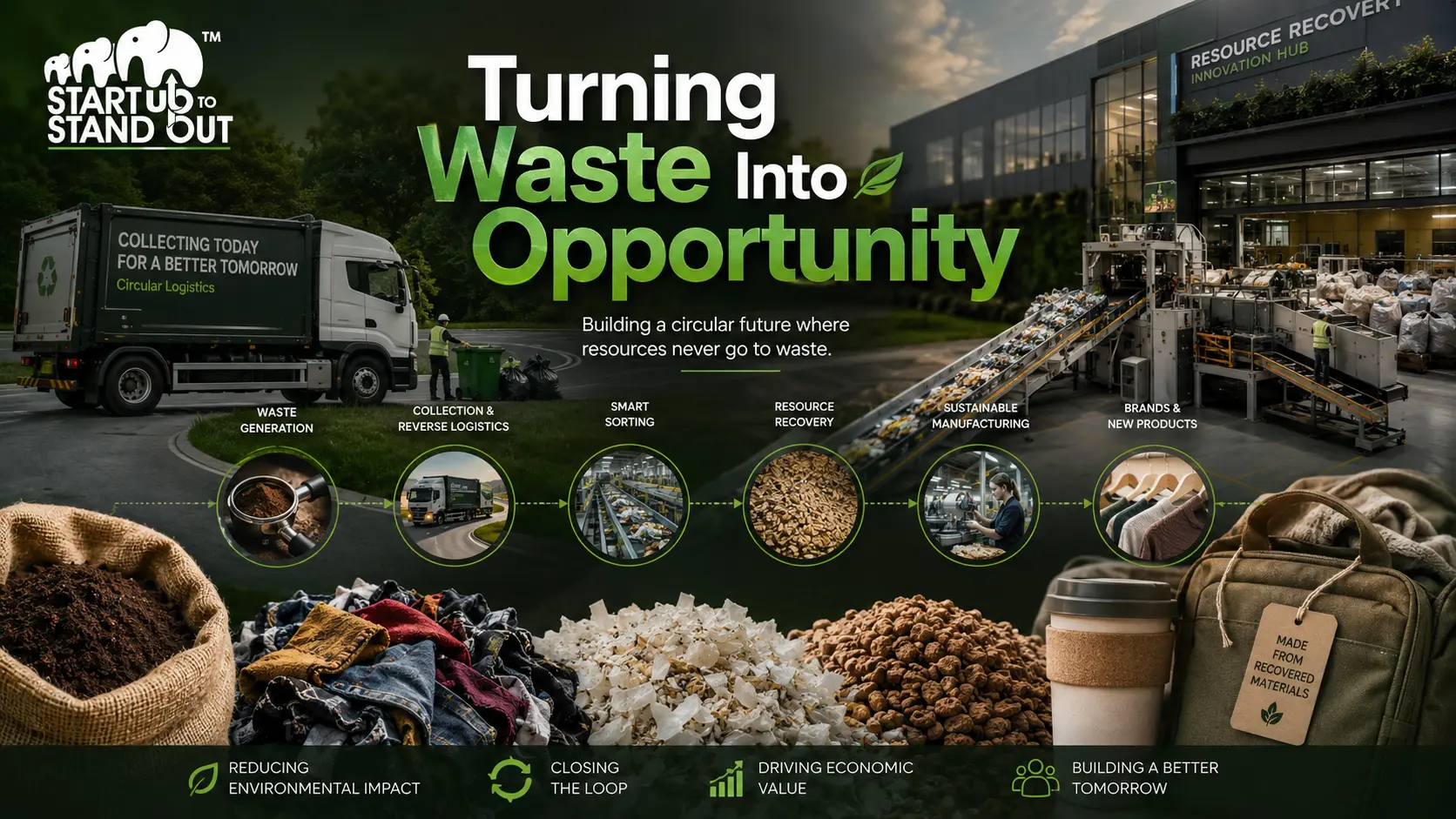
EcoLoop Logistics addresses this gap through a reverse logistics model.
Instead of treating waste as the end of a process, the platform reintegrates materials into the value chain.
The workflow is straightforward:
Collection
Waste is collected from businesses such as cafes, offices, manufacturers, and textile units.
Sorting and Quality Control
Materials are segregated and processed to meet quality requirements.
Redistribution
Recovered materials are supplied to:
- Upcycling businesses
- Eco-friendly brands
- Manufacturers
- Circular economy enterprises
This system transforms waste streams into supply chains.
Rather than paying solely for disposal, businesses participate in a network that extracts value from materials previously considered unusable.
Creating Value for Every Stakeholder
One of EcoLoop’s strongest advantages is that every participant benefits.
Waste Generators
Businesses gain a simpler disposal process while potentially monetizing waste streams.
Buyers
Manufacturers and upcycling companies receive consistent access to high-quality recovered materials.
Communities
Reduced landfill dependency contributes to cleaner local environments.
The Environment
Resource recovery reduces waste generation and lowers demand for virgin raw materials.
This alignment of incentives strengthens the long-term sustainability of the model.
Building a Business Around Waste Recovery
Environmental impact alone is rarely sufficient to build a scalable company.
EcoLoop’s business model incorporates multiple revenue streams designed to support profitability.
Green Disposal Fees
Businesses pay for reliable collection and waste management services.
Material Sales
Recovered materials are sold to manufacturers and upcycling businesses.
Subscription Pickups
Recurring collection schedules create predictable revenue.
Premium Material Services
Higher-quality or specialized waste streams command premium pricing.
Long-Term Supply Contracts
Bulk agreements provide stability for both buyers and sellers.
This diversified structure reduces dependence on any single revenue source.
The Operational Engine Behind Circular Logistics
The success of a circular economy platform depends heavily on execution.
Key operational activities include:
- Supplier onboarding
- Collection scheduling
- Transportation management
- Material sorting
- Quality assurance
- Demand matching
- Regulatory compliance
Unlike traditional waste management companies, EcoLoop functions as both a logistics provider and a marketplace coordinator.
Its value comes not only from moving materials but from ensuring they reach the right destination in a usable form.
Partnerships as a Competitive Advantage
No circular economy business can operate independently.
EcoLoop’s model relies on a network of strategic partnerships.
These include:
Waste Suppliers
- Cafes
- Restaurants
- Offices
- Textile businesses
- Manufacturers
Material Buyers
- Upcycling companies
- Sustainable brands
- Resource recovery businesses
Logistics Providers
Transportation partners support efficient material movement.
NGOs and Sustainability Organizations
Partnerships improve credibility, outreach, and ecosystem development.
Government and Municipal Authorities
Potential collaboration supports regulatory alignment and future expansion.
These relationships create network effects that become stronger as participation grows.
Environmental and Social Impact
The platform generates benefits beyond financial performance.
Reduced Landfill Waste
More materials remain within productive supply chains.
Conservation of Resources
Recovered materials reduce demand for newly extracted resources.
Job Creation
Growth in logistics, sorting, quality control, and supply chain operations supports employment.
Circular Economy Development
The model encourages industries to adopt more sustainable production practices.
These outcomes align with broader sustainability and climate objectives.
Future Growth Potential
The proposal outlines significant expansion opportunities.
Future developments may include:
- Multi-city deployment
- Smart city integration
- Digital marketplace platforms
- Real-time logistics tracking
- AI-driven route optimization
- Data analytics for waste forecasting
As environmental regulations tighten and sustainability becomes a competitive differentiator, demand for circular logistics solutions is likely to increase.
This creates favorable conditions for scalable growth.
Insights & Analysis
The most important innovation is not waste collection.
Waste collection already exists.
The innovation is supply chain design.
EcoLoop recognizes that waste becomes valuable when it is connected to demand.
Its true business is not disposal—it is resource matching.
This distinction matters because resource recovery markets are often more scalable and profitable than traditional waste management services. The more efficiently a platform connects supply with demand, the more value it creates for every participant in the ecosystem.
As industries increasingly embrace circular economy principles, businesses that control these material flows may become critical infrastructure providers rather than simple waste contractors.
Conclusion
Waste is often viewed as a problem to eliminate.
EcoLoop Logistics challenges that assumption.
By creating a circular supply network that collects, sorts, and redistributes materials, the platform transforms waste into a resource and disposal into an opportunity.
The model creates value for businesses, manufacturers, communities, and the environment while supporting a more sustainable approach to economic growth.
As companies face increasing pressure to improve sustainability performance and reduce environmental impact, circular logistics platforms may become an essential component of future supply chains.
The future of waste management may not be about throwing less away—it may be about recognizing that valuable resources were never waste in the first place.