










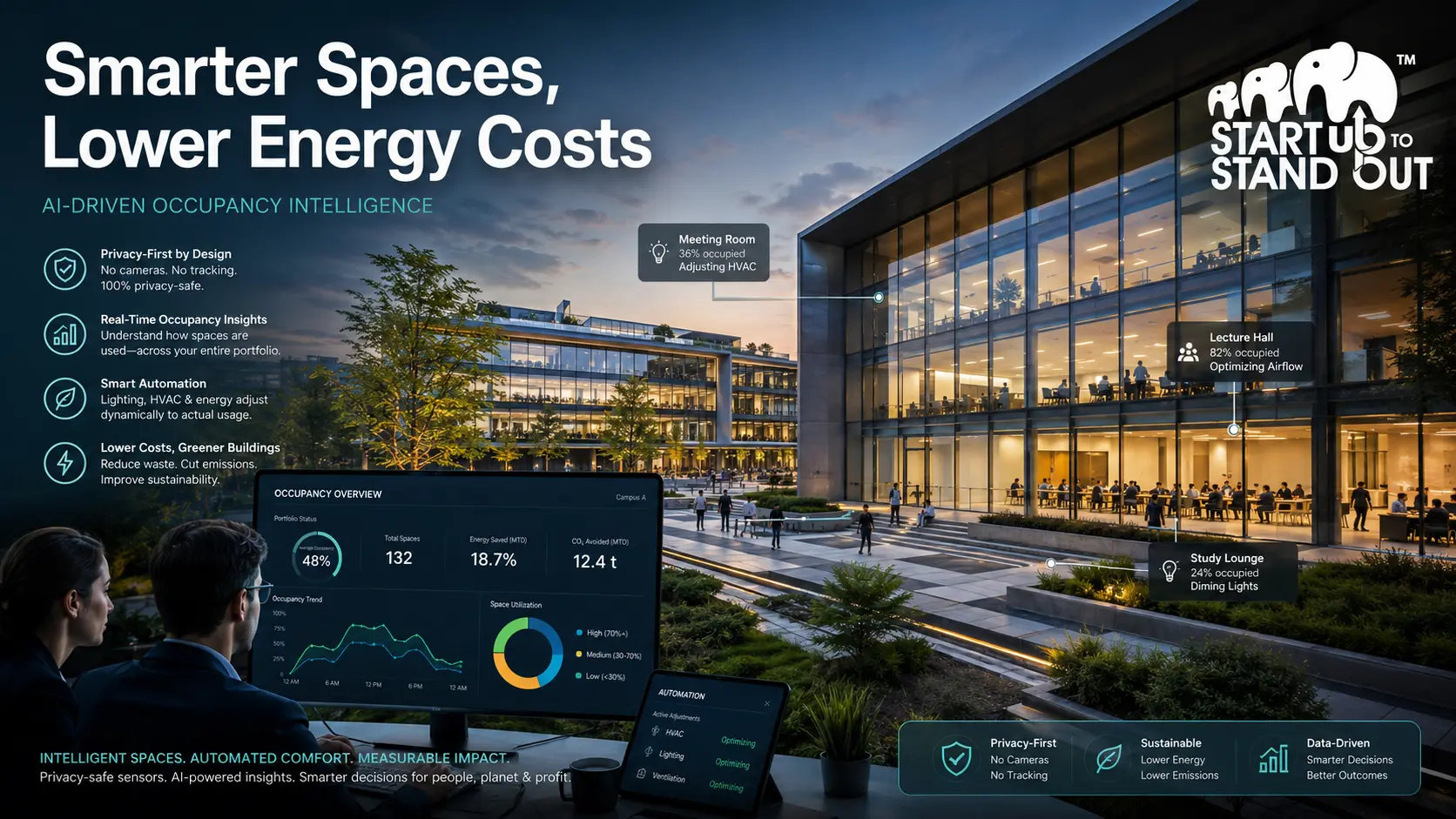
How AI Occupancy Intelligence Could Make Campuses and Buildings Smarter
Introduction
Modern buildings are becoming increasingly intelligent.
From automated lighting systems to IoT-connected infrastructure, organizations are investing heavily in technologies designed to improve efficiency and sustainability. Yet despite these advances, one fundamental question often remains unanswered:
How many people are actually using the space?
Educational institutions, corporate offices, and commercial facilities frequently operate without real-time occupancy data. Classrooms remain empty while air conditioning continues running. Meeting rooms sit unused despite appearing fully booked. Entire sections of buildings consume energy regardless of actual demand.
The result is wasted resources, higher operating costs, and inefficient space utilization.
SmartSpace AI aims to solve this challenge through a privacy-safe occupancy intelligence platform that combines multi-sensor technology, machine learning, and predictive analytics to help organizations understand how their spaces are truly being used.
The Hidden Cost of Poor Space Visibility
Most institutions manage physical spaces using static schedules rather than real-world usage data.
This creates several operational challenges:
- Underutilized classrooms and meeting rooms
- Overcrowded shared spaces
- Unnecessary energy consumption
- Poor resource allocation
- Limited facility planning insights
- Outdated manual management processes
In many buildings, lighting, air conditioning, and ventilation systems continue operating even when rooms remain empty for extended periods.
Without accurate occupancy information, facility managers are often forced to make decisions based on assumptions rather than evidence.
Why Traditional Occupancy Systems Face Resistance
Many occupancy monitoring systems rely heavily on cameras.
While effective for tracking movement, surveillance-based approaches introduce significant concerns:
Privacy Issues
Continuous video monitoring can create discomfort among students, employees, and visitors.
Regulatory Challenges
Organizations must comply with increasingly strict privacy and data protection regulations.
Higher Infrastructure Costs
Camera-based systems often require extensive hardware investments and storage infrastructure.
Trust Barriers
Users may resist technologies that feel invasive or overly monitored.
As a result, organizations frequently face a difficult trade-off between visibility and privacy.
A Privacy-First Alternative
SmartSpace AI takes a fundamentally different approach.
Instead of relying on cameras or facial recognition systems, the platform combines multiple non-visual sensors to detect occupancy while preserving privacy.
The system integrates:
BLE (Bluetooth Low Energy) Tracking
Detects nearby connected devices and occupancy patterns.
PIR Motion Sensors
Identify movement within physical spaces.
CO₂ Monitoring
Measures air quality changes associated with human presence.
Together, these sensors provide accurate occupancy intelligence without capturing personal images or identifying individuals.
This architecture allows organizations to gain valuable insights while maintaining user trust.
Turning Occupancy Data Into Intelligence
Collecting occupancy data is only the first step.
The real value comes from understanding what that data means.
SmartSpace AI incorporates machine learning models capable of:
- Predicting peak usage periods
- Forecasting occupancy trends
- Identifying underutilized spaces
- Optimizing room scheduling
- Supporting long-term infrastructure planning
As more data is collected, prediction accuracy improves over time.
This transforms occupancy monitoring from a reporting tool into a strategic decision-making platform.
Energy Optimization Through Automation
One of the platform’s most compelling use cases involves energy management.
Heating, ventilation, air conditioning (HVAC), and lighting systems account for a significant portion of operational expenses in large buildings.
By integrating occupancy intelligence with building automation systems, SmartSpace AI enables:
Automated Lighting Control
Lights activate only when spaces are occupied.
HVAC Optimization
Cooling and ventilation respond dynamically to actual demand.
Reduced Energy Waste
Unused rooms no longer consume unnecessary resources.
Improved Sustainability
Lower energy consumption contributes to reduced environmental impact.
For institutions managing dozens or hundreds of rooms, even modest efficiency gains can produce substantial savings.
Real-Time Visibility for Facility Managers
The platform includes a centralized analytics dashboard that provides:
- Live occupancy tracking
- Utilization reports
- Historical trends
- Capacity insights
- Energy optimization recommendations
Rather than waiting for manual audits or periodic reviews, facility managers gain continuous visibility into building performance.
This enables faster, more informed decisions regarding scheduling, infrastructure investments, and operational improvements.
A Strong Business Model for Smart Infrastructure
The proposal outlines a hybrid revenue model that combines hardware and software.
Revenue streams include:
Hardware Sales
Sensors, gateways, and installation components.
SaaS Subscriptions
Recurring software and analytics access.
Installation Services
Deployment and setup fees.
Maintenance Contracts
Ongoing support and system optimization services.
This structure creates predictable recurring revenue while supporting long-term customer relationships.
Market Expansion Opportunities
The initial focus is on educational institutions, where space utilization challenges are especially visible.
However, the broader opportunity extends into:
- Corporate offices
- Co-working spaces
- Smart commercial buildings
- Government facilities
- Healthcare institutions
- International smart infrastructure markets
Because the platform is largely software-driven after deployment, expansion can occur with relatively low marginal costs.
This scalability strengthens the long-term business case.
Social, Economic, and Environmental Impact
Social Impact
- Greater privacy protection
- Better campus experiences
- Smarter facility management
Economic Impact
- Reduced energy expenses
- Improved resource utilization
- Lower operational costs
Environmental Impact
- Reduced carbon emissions
- Lower energy consumption
- More sustainable building operations
These outcomes align closely with global sustainability and smart infrastructure initiatives.
Insights & Analysis
The most important aspect of SmartSpace AI is not occupancy detection.
Occupancy detection already exists.
The real innovation is combining privacy, intelligence, and automation into a single platform.
Many smart-building solutions force organizations to choose between accurate monitoring and user privacy. SmartSpace AI attempts to eliminate that trade-off through sensor fusion and AI-driven analytics.
This approach aligns with a broader trend across technology markets:
Organizations increasingly want data-driven intelligence without creating surveillance environments.
As privacy regulations tighten and sustainability goals become more important, solutions that deliver both operational visibility and trust are likely to gain significant traction.
Conclusion
Buildings generate enormous amounts of operational data, yet many organizations still lack visibility into one of the most important metrics: occupancy.
SmartSpace AI addresses this challenge through a privacy-safe platform that combines multi-sensor technology, machine learning, predictive analytics, and energy optimization.
By helping institutions understand how spaces are actually being used, the platform enables smarter scheduling, lower operating costs, reduced energy consumption, and better decision-making.
As campuses, offices, and commercial facilities continue evolving into intelligent environments, occupancy intelligence may become as fundamental as internet connectivity or cloud software.
The smartest buildings of the future will not simply be connected—they will understand how their spaces are being used in real time.