










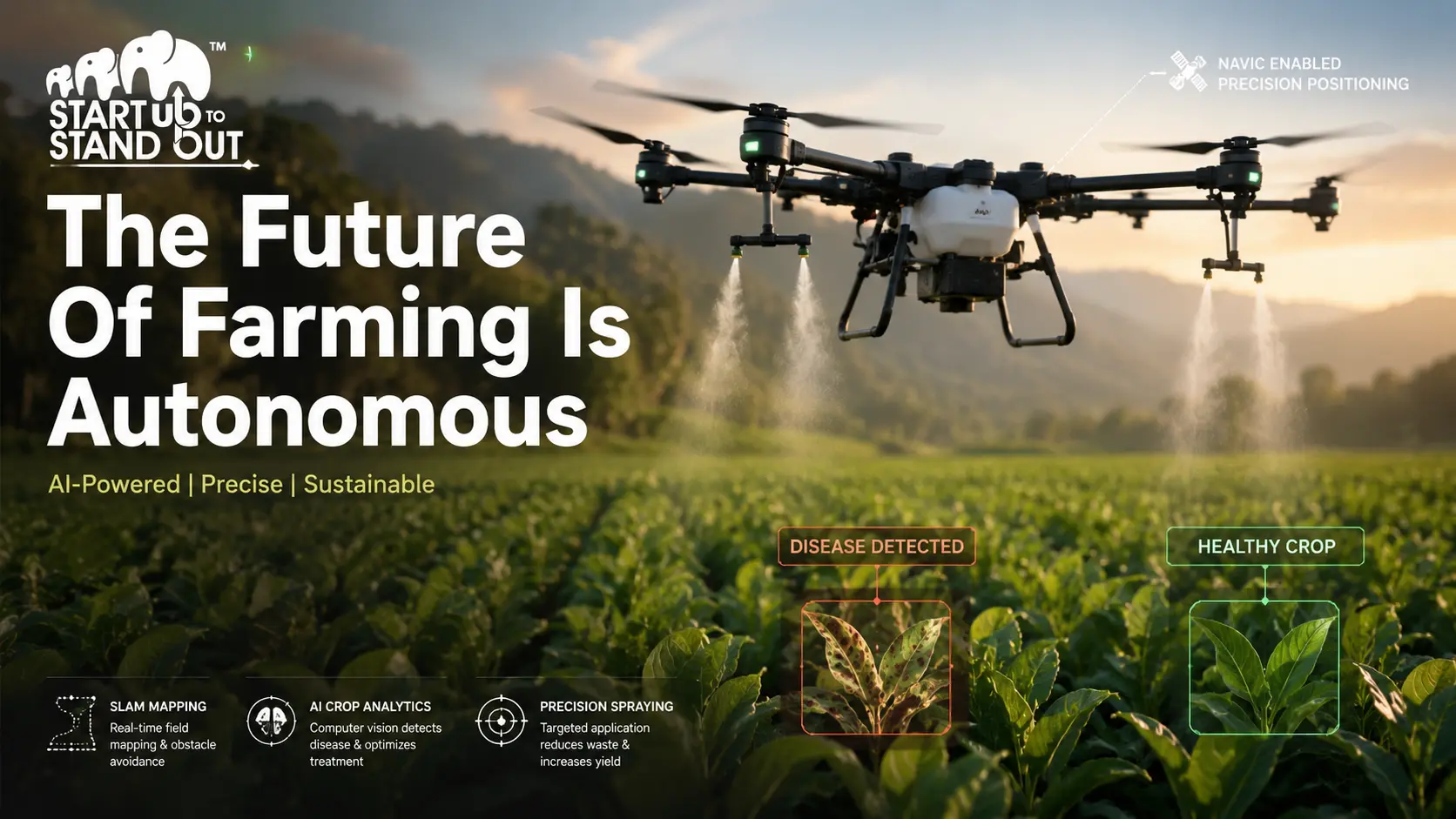
How AI-Powered Agricultural Robots Could Revolutionize Precision Farming
Introduction
Agriculture faces a difficult balancing act.
Farmers must increase productivity to feed growing populations while simultaneously reducing costs, minimizing environmental impact, and coping with labor shortages. Traditional farming practices are struggling to meet these competing demands.
One of the biggest inefficiencies lies in how crops are monitored and treated. Large volumes of pesticides are often sprayed uniformly across entire fields regardless of whether every plant actually needs treatment. This leads to unnecessary costs, environmental damage, and reduced efficiency.
At the same time, labor shortages and the expansion of controlled-environment farming are creating new operational challenges that traditional equipment was never designed to solve.
Team Sindhudurg’s AgroGuard platform seeks to address these issues through an integrated ecosystem of AI-powered agricultural robotics, combining computer vision, autonomous navigation, and indigenous satellite technology to bring precision farming within reach of Indian farmers.
The Hidden Cost of Traditional Farming
Modern farming still relies heavily on manual inspections and blanket chemical application.
This approach creates several major problems:
- Excessive pesticide usage
- Higher operating costs
- Environmental contamination
- Labor-intensive crop monitoring
- Reduced treatment efficiency
According to the proposal, approximately 40% of pesticides are wasted because chemicals are sprayed on healthy plants and unaffected areas rather than being targeted precisely where needed.
This inefficiency directly impacts profitability while increasing environmental pressure on agricultural ecosystems.
Why Precision Agriculture Matters
Precision agriculture aims to solve this problem through data-driven decision-making.
Instead of treating every plant identically, technology identifies specific areas that require intervention and applies resources accordingly.
The benefits include:
Lower Input Costs
Reduced chemical usage lowers overall operating expenses.
Better Crop Health
Targeted treatment improves effectiveness while minimizing unnecessary exposure.
Environmental Sustainability
Less chemical runoff helps protect soil quality and local water systems.
Higher Productivity
Farmers can focus resources where they create the greatest impact.
However, implementing precision agriculture at scale requires technologies capable of collecting and acting upon large amounts of field data in real time.
The AgroGuard Solution
AgroGuard combines artificial intelligence, autonomous robotics, and precision spraying technologies into a single integrated platform.
Rather than relying on continuous blanket spraying, the system uses onboard intelligence to identify crop diseases and pest infestations before applying treatment.
The result is a more efficient and targeted farming process.
AI-Powered Disease Detection
At the core of the system is a computer vision engine based on YOLOv8 models.
The AI continuously analyzes crops and identifies:
- Disease symptoms
- Pest infestations
- Crop health anomalies
Treatment is triggered only when the system confirms a target requiring intervention.
This selective spraying approach significantly reduces chemical waste while improving treatment precision.
Solving Agriculture’s Indoor Navigation Problem
One of the most unique aspects of AgroGuard is its ability to operate in polyhouses and greenhouse environments.
Traditional agricultural drones rely heavily on GPS signals.
Inside enclosed structures, these signals become unreliable or unavailable altogether.
AgroGuard addresses this challenge through:
SLAM Technology
Simultaneous Localization and Mapping enables the robot to build real-time maps of its surroundings while determining its own position.
ArUco Marker Navigation
Visual markers help maintain accurate positioning and route planning within confined environments.
LiDAR-Based Awareness
Environmental sensing allows autonomous movement without relying solely on satellite navigation.
This capability opens opportunities in high-value agriculture segments where automation solutions have traditionally been limited.
Why NAVIC Creates a Competitive Advantage
The platform also incorporates India’s indigenous NAVIC satellite navigation system.
Compared to conventional GPS-based systems, NAVIC offers enhanced accuracy across the Indian subcontinent.
Advantages include:
- Improved positioning precision
- Greater reliability in remote areas
- Better suitability for Indian operating conditions
- Reduced dependence on foreign navigation infrastructure
For agriculture, even small improvements in positioning accuracy can significantly improve treatment consistency and operational efficiency.
A Business Model Built Around Accessibility
One of the biggest challenges in agricultural technology adoption is affordability.
Many farmers cannot justify large capital investments in advanced robotics.
AgroGuard addresses this through multiple access models.
Robot-as-a-Service (RaaS)
Farmers access technology through leasing arrangements rather than outright purchases.
Pay-Per-Use Services
Per-acre pricing allows seasonal users to pay only when services are needed.
Subscription Intelligence
Recurring crop health reports and predictive analytics create ongoing value beyond hardware deployment.
API Licensing
The company’s AI models can also be licensed to other agricultural technology providers.
This diversified structure reduces barriers to adoption while creating predictable recurring revenue streams.
Building an Agricultural Ecosystem
AgroGuard’s strategy extends beyond robotics.
The proposal outlines partnerships across:
- ISRO and NAVIC ecosystems
- Agricultural cooperatives
- Farmer Producer Organizations (FPOs)
- Government subsidy programs
- Agri-chemical companies
- Digital agriculture platforms
These partnerships help strengthen distribution, reduce adoption friction, and improve scalability.
By integrating into existing agricultural networks, the platform increases its likelihood of widespread adoption.
Insights & Analysis
The most important aspect of AgroGuard is not the drone itself.
It is the combination of precision agriculture and recurring intelligence services.
Many agricultural technology companies focus solely on selling hardware. AgroGuard instead positions itself as a long-term agricultural intelligence platform.
The hardware collects data.
The AI interprets it.
The subscription services monetize it.
This creates a business model with stronger margins and greater scalability than one-time equipment sales alone.
As agriculture becomes increasingly data-driven, companies that own actionable field intelligence may ultimately become more valuable than those that simply manufacture equipment.
Conclusion
Agriculture is under growing pressure to become more productive, sustainable, and resilient.
Traditional approaches to crop monitoring and chemical application are becoming increasingly difficult to justify in a world that demands greater efficiency.
AgroGuard demonstrates how artificial intelligence, autonomous robotics, SLAM navigation, and NAVIC positioning can work together to address some of farming’s most persistent challenges.
By reducing chemical waste, improving crop monitoring, solving labor shortages, and making advanced technology more accessible through service-based pricing models, the platform offers a compelling vision for the future of Indian agriculture.
The next generation of farming may not be defined by larger machinery or more chemicals. It may be defined by smarter machines making better decisions, one plant at a time.
About the Authors
This article was collaboratively prepared by:
- Sonia Pagare
- Sudarshan Joshi
- Pratik Suryawanshi
- Aayushi Tidke
- Srushti Ukirde
- Yash Shinde
- Tanishq Gaikwad